
TL;DR:
- Appliance motor types affect durability, repairability, and energy efficiency.
- Regular maintenance and proper load management extend motor lifespan and prevent breakdowns.
- Early signs like noise, vibration, or burning smells indicate potential motor issues.
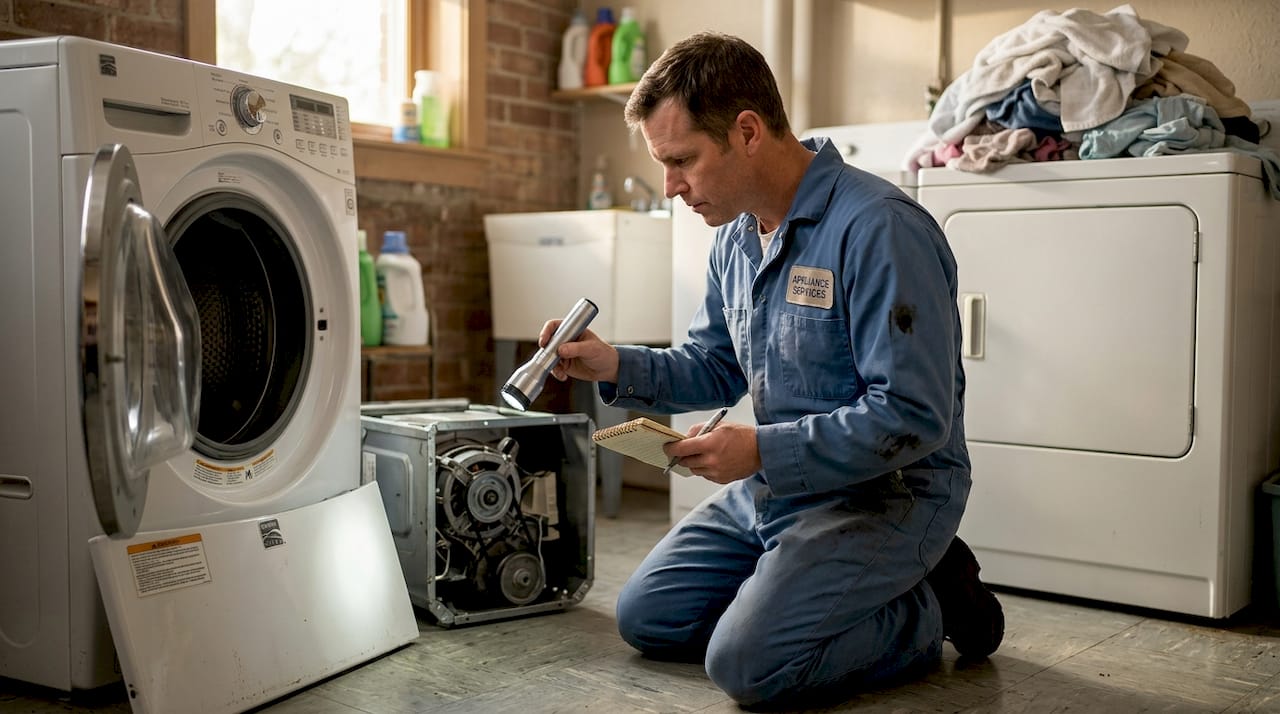
Your washing machine stops mid-cycle. Your dryer runs but produces no heat. Your refrigerator hums louder than usual, then goes silent. These aren’t random events. In most cases, the motor is at the center of the problem. Homeowners and small business owners in Monmouth County, NJ deal with these breakdowns every week, often without knowing what actually failed or why. Understanding how appliance motors work gives you a real advantage: you can spot warning signs early, have smarter conversations with repair technicians, and make better decisions about whether to fix or replace a struggling appliance.
Table of Contents
- The basics: Types of appliance motors and their roles
- Inside the motor: How appliance motors generate motion
- What causes motor issues: Common failures and what to watch for
- Repair or replace? Making smarter motor decisions
- What most homeowners and businesses miss about appliance motors
- Get expert appliance repair and maintenance in Monmouth County
- Frequently asked questions
Key Takeaways
| Point | Details |
|---|---|
| Know your motor type | Understanding the kind of motor in your appliance helps with targeted maintenance and troubleshooting. |
| Detect issues early | Watch for unusual noise, vibration, or power drops to avoid expensive repairs. |
| Prioritize efficient motors | Choosing motors with higher efficiency ratings saves energy and reduces breakdowns. |
| Repair smartly | Evaluate repair vs replacement costs and appliance age before making a decision. |
| Maintenance saves money | Regular checks and maintenance reduce motor failures and keep appliances running longer. |
The basics: Types of appliance motors and their roles
Not all appliance motors are built the same, and that difference matters more than most people realize. The type of motor inside your washer, dryer, or refrigerator directly affects how long it lasts, how easy it is to repair, and how much energy it uses. Getting familiar with the main types helps you understand why some appliances are more reliable than others.
The three most common motor types in household appliances are brushed DC motors, induction motors, and synchronous motors.
- Brushed DC motors use physical carbon brushes to transfer electrical current to the rotating part. They’re common in older washers and some vacuum cleaners. They’re relatively simple but wear out faster because the brushes erode over time.
- Induction motors run on AC power and use electromagnetic fields to spin the rotor without physical contact. They’re found in refrigerators, dishwashers, and many modern washers. They’re durable and low-maintenance.
- Synchronous motors rotate at a fixed speed tied to the power supply frequency. You’ll find them in clocks, some fans, and microwave turntables. They’re precise but not designed for heavy loads.
Beyond motor type, the way a motor connects to the working parts of an appliance matters a lot. Here’s a quick comparison:
| Motor connection | How it works | Common appliances | Key tradeoff |
|---|---|---|---|
| Belt-driven | Motor uses a belt and pulley to transfer power | Older washers, dryers | Easy access, but belts wear out |
| Direct-drive | Motor attaches directly to the drum or mechanism | Modern washers, some dryers | Fewer parts, quieter operation |
| Gear-driven | Motor uses gears to transfer motion | Stand mixers, some dryers | High torque, more complex |
Direct-drive motors have become the standard in newer washing machines because they reduce vibration and noise by eliminating the belt and pulley system. Fewer moving parts also means fewer things that can break. Belt-driven designs, while older, are actually easier to work on since the motor sits separately and is more accessible.
Knowing your motor type also helps you prevent appliance damage before it starts. Overloading a belt-driven washer strains the belt first. Overloading a direct-drive unit puts stress directly on the motor shaft. Same symptom, different root cause, different fix.
Inside the motor: How appliance motors generate motion
With types and roles clarified, let’s see how motors actually produce motion inside your appliances.
At the core, every electric motor converts electrical energy into mechanical motion using magnetic fields. It sounds complex, but the process follows a clear sequence:
- Power enters the motor through the power supply, either AC (alternating current) from your wall outlet or DC (direct current) from a battery or converter.
- Current flows through the windings, which are coils of wire wrapped around the motor’s core. This creates a magnetic field.
- The magnetic field interacts with the rotor, which is the spinning part of the motor. The opposing magnetic forces push the rotor into motion.
- The rotor spins the shaft, which connects to whatever the appliance needs to move: a drum, a fan blade, a pump impeller.
- Speed and torque are controlled by adjusting the voltage, frequency, or current depending on the motor type.
The efficiency of this process varies significantly. Premium efficiency motors operate between 88% and 94% efficiency, while standard motors often fall below 85%. IE3 class motors, common in newer appliances, typically hit 86% to 89% efficiency for small motor sizes. That gap adds up on your energy bill over months and years.
Two parts of the motor degrade faster than anything else: the windings and the bearings. Windings can develop shorts or breaks from heat and age. Bearings allow the rotor to spin smoothly, and when they wear out, you get noise, vibration, and eventually seizure.
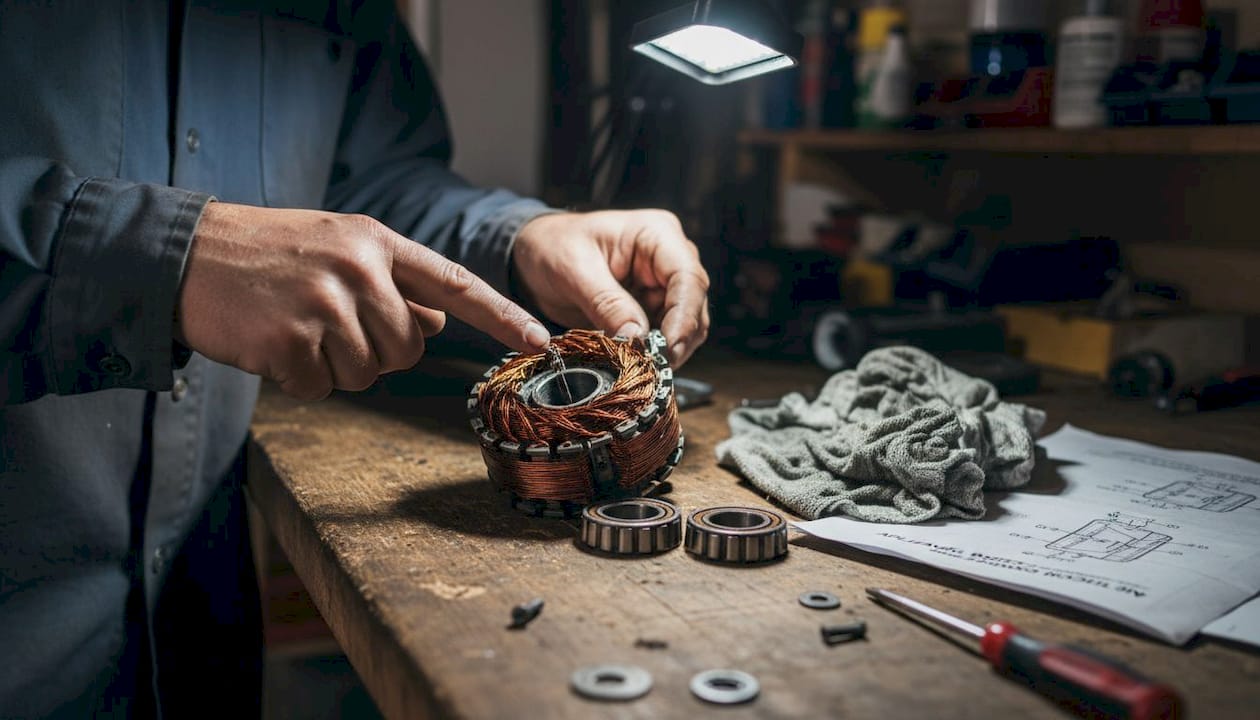
Pro Tip: If your appliance makes a grinding or squealing sound during operation, that’s often a bearing on its way out. Catching it early means a simple bearing replacement instead of a full motor swap. You can also check appliance maintenance tips to stay ahead of these issues.
Understanding how sensors improve appliance efficiency also ties into motor health. Modern appliances use sensors to adjust motor load in real time, which reduces wear and extends motor life considerably.
What causes motor issues: Common failures and what to watch for
Understanding how motors work is half the battle; knowing what can go wrong is just as crucial.
Most motor failures don’t happen without warning. They build up over time through stress, wear, and neglect. The three most common causes are overload, imbalance, and brush wear.
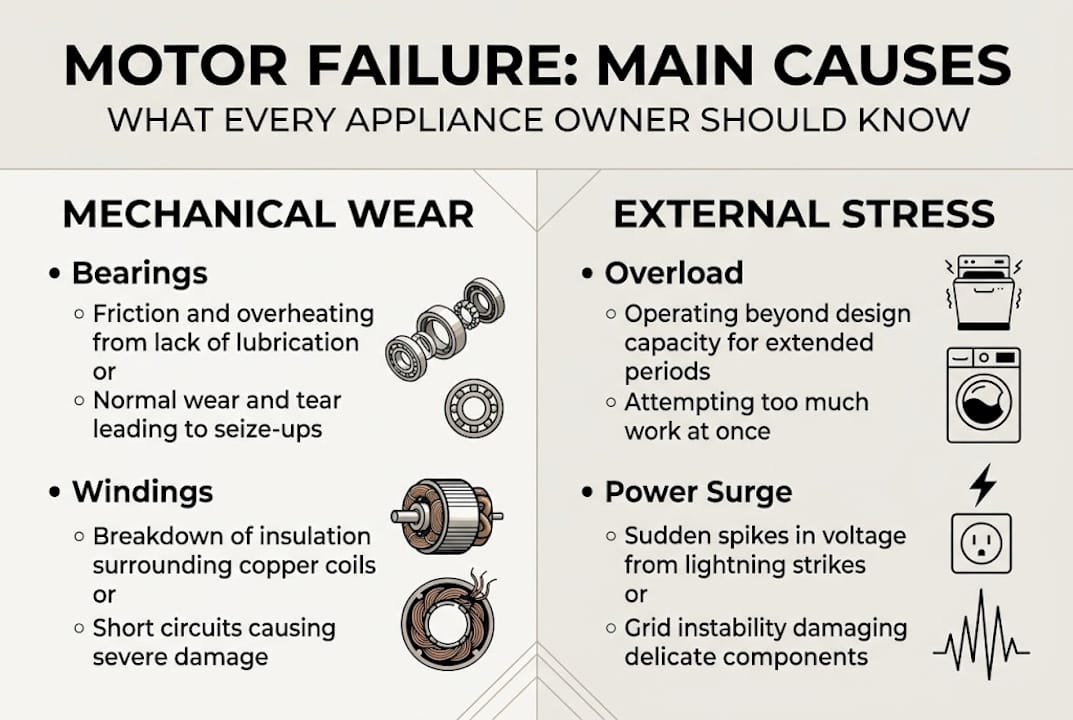
Overload reduces efficiency and torque, forcing the motor to work harder than it was designed to. Over time, this causes the windings to overheat and fail. Imbalance, often from an uneven load in a washer or a worn drum bearing, causes vibration that slowly damages the rotor and shaft. In brushed motors, the carbon brushes wear down and eventually lose contact with the commutator, causing the motor to run poorly or stop entirely.
Here are the warning signs every Monmouth County homeowner should know:
- Loud grinding or squealing: Usually a bearing problem. Don’t ignore it.
- Burning smell during operation: Overheating windings. Shut the appliance off immediately.
- Excessive vibration: Could be imbalance, a worn bearing, or a failing rotor.
- Sudden power loss or intermittent operation: Often a brush issue in older motors or a winding failure.
- Appliance running but not performing: Motor is spinning but not generating enough torque, usually from overload damage.
“Regular maintenance and correct load sizing are the most effective ways to extend motor life and prevent unexpected failures.”
Pro Tip: Before calling a technician, do a quick check. Is the appliance overloaded? Is it sitting on an uneven surface? Is the vent or filter clogged, causing the motor to overheat? These simple checks can save you a service call. For more detailed guidance, appliance troubleshooting tips walk you through common problems step by step.
For smaller appliances like vacuums and mixers, small appliance repair essentials covers the specific failure points you’re most likely to encounter.
Repair or replace? Making smarter motor decisions
When problems arise, quick action and the right choice can save both money and stress.
The repair versus replace decision comes down to four factors: the cost of repair, the age of the appliance, the availability of parts, and how accessible the motor is. Here’s a practical approach to working through it:
- Check the basics first. Test the power switch, inspect the power cord, and look for visible damage. Many apparent motor failures are actually switch or connection problems that cost very little to fix.
- Inspect the bearings. Spin the drum or moving part by hand. Rough, grinding movement means worn bearings. Bearing replacement is usually affordable.
- Check the windings. A technician can use a multimeter to test for shorts or open circuits in the windings. This tells you whether the motor itself is still viable.
- Get a repair estimate. If the repair cost is more than 50% of the cost of a new unit, replacement is almost always the smarter financial move.
- Factor in age. An appliance that’s already 12 to 15 years old may not be worth repairing even if the fix seems affordable, because other components are likely near the end of their life too.
Direct-drive motors are quieter and more reliable, but they’re harder to access for repairs. Belt-driven systems are easier to work on but require periodic belt replacement. Knowing which type you have changes the cost equation.
IE3+ motors save over 4% energy compared to older motor classes, and proper maintenance cuts motor failures by two-thirds. If you’re replacing an older appliance, choosing a model with a higher efficiency motor pays back quickly.
Pro Tip: Match the load to the appliance’s rated capacity and keep it level. Misalignment and overloading are the two fastest ways to shorten motor life. Detailed guidance on appliance care best practices and diagnosing appliances can help you build a simple routine that protects your investment.
What most homeowners and businesses miss about appliance motors
Here’s what most guides don’t tell you: the biggest driver of appliance motor failure isn’t age or cheap parts. It’s the assumption that appliances are maintenance-free. People run washers overloaded, ignore early vibration, and skip filter cleaning until the motor overheats. Then they’re surprised when it fails.
After decades of serving Monmouth County homeowners and businesses, we’ve seen this pattern repeat constantly. The appliances that last 15 or 20 years belong to people who pay attention to small changes: a new noise, a slight vibration, a longer cycle time. Those signals are the motor asking for help before it quits.
Knowing whether your appliance has a brushed or induction motor, a belt-driven or direct-drive setup, changes how you maintain it and what you watch for. That knowledge isn’t just interesting. It’s practical and saves real money. Our Monmouth County appliance tips give you location-specific guidance built around the appliances and conditions common to this area.
Get expert appliance repair and maintenance in Monmouth County
If you’re ready to apply these insights or need help with appliance motor repairs, local pros can make all the difference.

At Expert Appliance Repair, we’ve been helping Monmouth County homeowners and small businesses since 1988. Whether your washer motor is grinding, your dryer isn’t spinning, or you just want a professional eye on your appliances before something breaks, we’re ready to help. We service all major appliance brands and offer same-day appointments across the area. From full appliance and vacuum repair to proactive checkups using our appliance maintenance checklist, our team gives you straightforward answers and honest pricing every time.
Frequently asked questions
What’s the difference between a belt-driven and direct-drive motor?
Belt-driven motors use a pulley between the motor and drum; direct-drive motors connect directly, offering quieter operation and fewer moving parts.
How can I tell if an appliance motor needs repair or replacement?
Check switches, bearings, and windings first; if repairs cost more than half the price of a new unit or the appliance is old, replacement may be best.
Why is motor efficiency important in appliances?
Higher efficiency means lower energy bills and fewer breakdowns; IE3+ motors save over 4% energy according to industry benchmarks.
What are signs of motor failure in appliances?
Common signs include loud noise, excessive vibration, burning smells, or sudden power loss, often linked to overload or brush wear inside the motor.
Does regular motor maintenance make a difference?
Yes, proper maintenance like alignment and correct load sizing cuts motor failures by two-thirds, making it one of the highest-value habits for any appliance owner.
Recommended
- Master the Reliable Appliance Repair Process for Fast Results – Expert Appliance
- Boost Your Home’s Efficiency with Reliable Appliance Repairs – Expert Appliance
- How to Diagnose Appliances for Quick Home Repairs – Expert Appliance
- Master the Appliance Service Workflow for Fast Repairs – Expert Appliance