
TL;DR:
- Fuses act as safety devices that prevent electrical fires by breaking circuits during overcurrent or overheating.
- When a fuse blows, it does so rapidly through Joule heating, melting a metal element to stop current flow.
- Repeated fuse failures indicate underlying issues and require proper diagnosis to prevent damage and hazards.
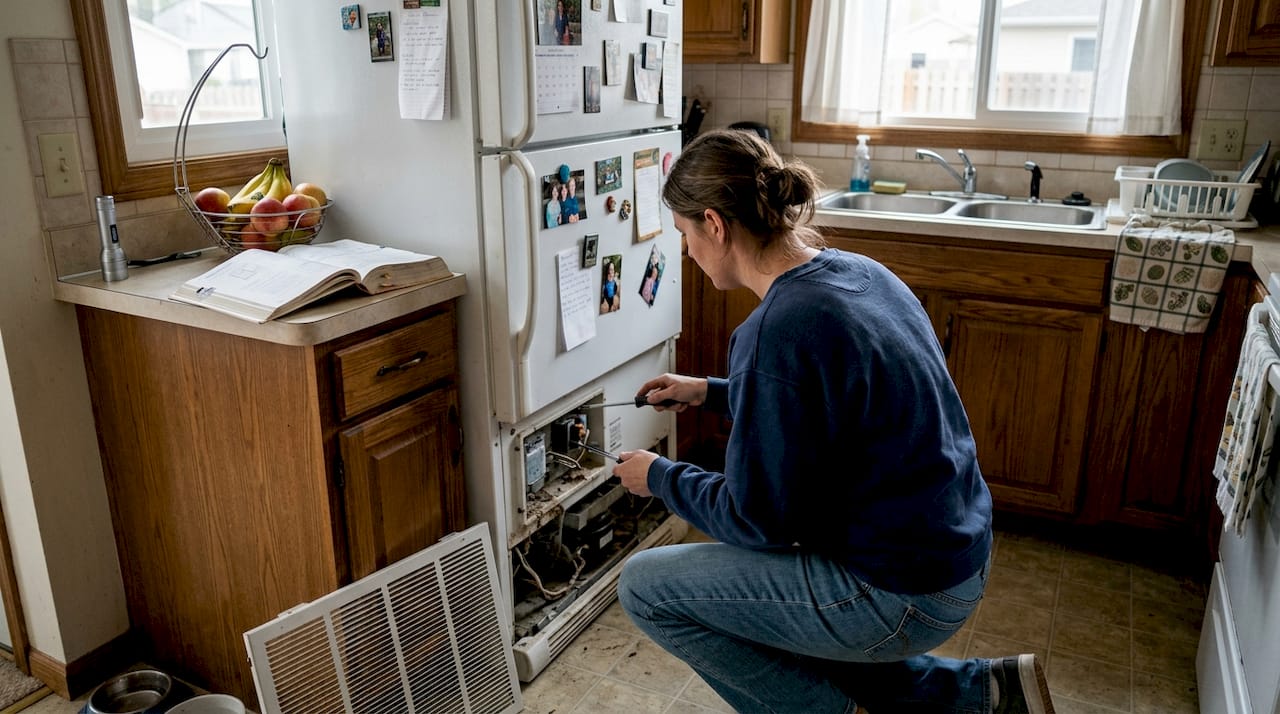
Most people think of a blown fuse as a minor inconvenience, something to swap out quickly and forget about. But that small, inexpensive component is often the only thing standing between your appliance and a serious electrical fire. Fuses are not trivial. They are precision safety devices that protect your home, your family, and your equipment every single day. This guide walks you through exactly what appliance fuses do, what really happens when one blows, the most dangerous mistakes people make when dealing with them, and how to recognize when a fuse problem is really a sign of something much bigger.
Table of Contents
- What does an appliance fuse actually do?
- Inside the fuse: How and why it blows
- Troubles with fuses: When replacement isn’t enough
- Choosing and comparing: Types of appliance fuses
- Why most fuse problems are preventable with a smarter approach
- Get expert appliance fuse help in Monmouth County
- Frequently asked questions
Key Takeaways
| Point | Details |
|---|---|
| Critical safety barrier | Appliance fuses cut off dangerous current flow to stop fires and damage instantly. |
| Blown fuse signals trouble | Replacing fuses repeatedly means deeper issues need urgent attention, not just a swap. |
| Match fuse to appliance | Always use the correct type and rating when replacing fuses to ensure top-level protection. |
| Pro maintenance saves pain | Prevent future fuse and appliance headaches with proactive inspections and expert help. |
What does an appliance fuse actually do?
Now that you know why you shouldn’t ignore a blown fuse, let’s look at what fuses are designed to do. At its core, a fuse is a sacrificial safety device. It is built to fail on purpose so that your appliance and your home wiring do not. The moment electrical current spikes beyond a safe level, the fuse element melts and breaks the circuit, stopping the dangerous flow of electricity before it can do real damage.
Appliance fuses serve as sacrificial safety devices that interrupt electrical current during overcurrent or excessive heat to prevent fires and protect circuits. That is not just a technical detail. It means that when your washing machine’s motor seizes or your oven’s heating element shorts out, the fuse takes the hit so your walls, wiring, and appliance cabinet do not.
Here is what a fuse protects against in everyday situations:
- Overcurrent events: When too much current flows through a circuit, the fuse element melts and breaks the connection.
- Short circuits: A direct connection between live wires causes a massive current spike. The fuse reacts in an instant.
- Overheating: Thermal fuses respond to temperature rather than current, protecting motors and heating elements from runaway heat.
- Equipment damage: By cutting power immediately, fuses prevent cascading failures that could destroy expensive components.
Understanding fuse basics helps you see why the right fuse for the right job is not optional. A fuse rated too high will not trip when it should. A fuse rated too low will blow constantly under normal load. The match has to be exact.
Remember: A fuse that blows is doing its job correctly. The real question is always why it blew, not just how fast you can replace it.
For homeowners in Monmouth County, understanding appliance safety in NJ starts with respecting what fuses actually do. Reviewing a home appliance safety checklist can also reveal whether your appliances are properly protected in the first place.
Inside the fuse: How and why it blows
Once you know fuses are designed to sacrifice themselves for safety, it’s natural to wonder: what exactly happens in those crucial moments when a fuse blows? The answer involves a basic physics principle that has big real-world consequences.
Fuses rely on what engineers call Joule heating, sometimes written as I²R. In plain terms, when current flows through a conductor, it generates heat. The more current, the more heat. A fuse element is made from a metal alloy specifically chosen to melt at a precise temperature. When current exceeds the fuse’s rating, heat builds up rapidly until the element melts, breaking the circuit completely.
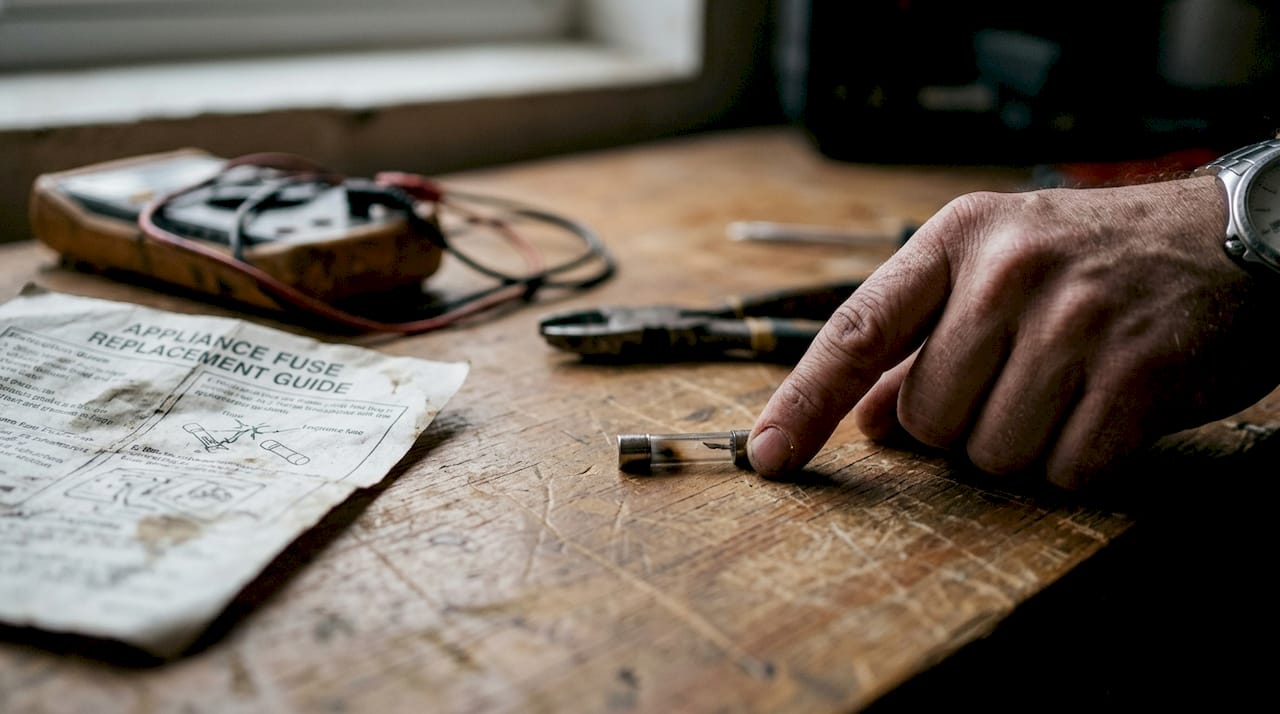
Current-limiting fuses interrupt in less than half a cycle, which means they can act in well under 10 milliseconds at 60 Hz. That is faster than any mechanical switch or circuit breaker. For appliances with sensitive electronics, like modern refrigerators or smart dishwashers, that speed can mean the difference between a blown fuse and a destroyed control board.
Here is the step-by-step sequence of what happens when a fuse blows:
- Electrical current in the circuit rises above the fuse’s rated limit.
- Joule heating causes the fuse element temperature to climb rapidly.
- The element reaches its melting point and liquefies, breaking the metallic path.
- An electrical arc may form across the gap as the element separates.
- Filler material inside the fuse body, usually silica sand, absorbs the arc energy and quenches it safely.
- The circuit is fully open. Current stops. Damage is prevented.
Stat callout: Current-limiting fuses can interrupt fault currents in as little as 4 milliseconds, according to fuse timing data from industry specifications.
| Fuse response stage | What happens | Time scale |
|---|---|---|
| Overcurrent begins | Current exceeds rated limit | 0 ms |
| Heating phase | Element temperature rises due to I²R | 1 to 10 ms |
| Element melts | Circuit opens, arc forms | Under 10 ms |
| Arc quench | Filler absorbs arc energy | Milliseconds |
| Full interruption | Current completely stopped | Under half cycle |
The fuse mechanics behind arc control are critical. Without proper filler material, the arc could sustain current flow even after the element melts, which would defeat the purpose entirely. Quality fuses are engineered so that every stage of this sequence works correctly under real-world fault conditions. This is why cheap, off-brand fuses are a genuine safety risk. Understanding appliance safety and fuse action in your home means trusting components that are built to the right specifications.
Troubles with fuses: When replacement isn’t enough
Knowing how a fuse works is only half the story. Understanding what to do when fuses keep failing saves you time and money. Replacing a blown fuse and moving on sounds simple, but it can be a costly mistake if the underlying cause is not addressed.
Repeated fuse blowing usually means underlying faults like short circuits, faulty elements, or wrong fuse ratings. Never bypass a fuse. That is not just good advice. It is a rule that prevents house fires and destroyed appliances.
The most common reasons fuses keep blowing include:
- Short circuits: Damaged wiring or failed components cause current to take an unintended path, spiking instantly. Learn more about why appliances short circuit to spot warning signs early.
- Faulty heating elements or motors: A partially failed element draws far more current than normal before it completely gives out.
- Wrong fuse rating: Installing a fuse with too low a rating causes nuisance blowing under normal load. Too high a rating means the fuse never protects properly.
- Moisture intrusion: Water inside an appliance creates new conductive paths, leading to repeated shorts and blown fuses.
- Overloaded circuits: Plugging too many high-draw appliances into one outlet or circuit causes repeated trips.
Pro Tip: If the same fuse blows more than twice, stop replacing it and start diagnosing. Repeated fuse failures are your appliance sending a clear distress signal. Use a resource like diagnose appliance problems to work through what might be causing the pattern.
The most dangerous mistake homeowners make is uprating, installing a higher-amperage fuse to stop the nuisance blowing. This does not fix the problem. It removes the last layer of protection. A 20-amp fuse in a circuit designed for 15 amps will allow current to flow at levels that can melt wiring insulation and start fires inside your walls. Review causes of blown fuses before you assume a simple replacement is all that is needed.
Ignoring repeated fuse issues also escalates repair costs dramatically. A shorted heating element caught early might cost a few hundred dollars to fix. Left unchecked while fuses are being repeatedly replaced, the same fault can destroy a control board, damage wiring harnesses, or even cause a fire. Check out appliance troubleshooting solutions for a broader look at how these problems connect.
Choosing and comparing: Types of appliance fuses
The right solution starts with understanding your options. Here is how different fuse types stack up for various appliance needs.
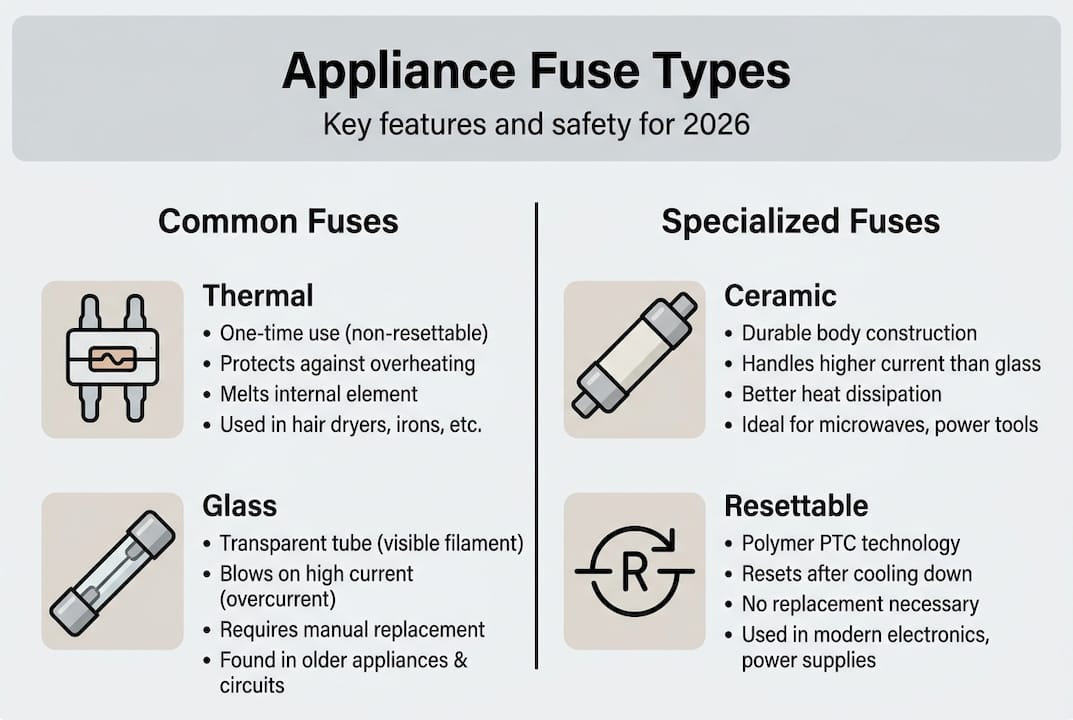
Not all fuses behave the same way, and using the wrong type is just as dangerous as using the wrong rating. Fuse selection must be precise: match type, interrupting rating, and standards such as UL 248 and NEC 430.72 to the specific appliance. This is not just a technicality. Standards exist because appliances behave differently under fault conditions.
| Fuse type | Response speed | Resettable? | Best for |
|---|---|---|---|
| Fast-acting (fast-blow) | Milliseconds | No | Sensitive electronics, control boards |
| Time-delay (slow-blow) | Seconds | No | Motors, compressors, startup surges |
| Thermal fuse | Temperature-triggered | No | Dryers, ovens, overheating protection |
| Resettable fuse (PPTC) | Self-resetting | Yes | Low-power devices, USB ports |
| Circuit breaker | Variable | Yes | Whole circuits, panel protection |
Key differences worth knowing:
- Fast-acting fuses react immediately to overcurrent. They are ideal for protecting printed circuit boards and sensitive controls but will blow during the normal startup surge of a motor.
- Time-delay fuses tolerate brief inrush currents, making them the right choice for washing machine motors, refrigerator compressors, and air conditioner units that draw extra current on startup.
- Thermal fuses do not respond to electrical overload at all. They open only when temperature exceeds a set point, making them essential inside dryers and ovens. They are always one-time use. Once open, they must be replaced.
See how fuses vs breakers differ in terms of response time and protection level before assuming a tripped breaker and a blown fuse are equivalent events. They are not.
Pro Tip: When replacing a thermal fuse in a dryer, always check the exhaust vent for blockage first. A clogged vent is the number one cause of appliance shorts and overheating in dryers. Replacing the fuse without clearing the vent means the new fuse will blow again within weeks.
Why most fuse problems are preventable with a smarter approach
After years of repairing appliances across Monmouth County, we have seen the same pattern repeat itself: a homeowner replaces a blown fuse, the appliance works for a few weeks, then the fuse blows again. This cycle continues until something more expensive fails. The honest truth is that most fuse problems are not really fuse problems. They are maintenance problems wearing a fuse problem’s disguise.
Fuses are the last line of defense, not the first. When they blow, something upstream has already gone wrong. Ignoring repeated fuse failures is the equivalent of pulling your car’s engine warning light fuse to stop the light from bothering you. The underlying issue keeps getting worse.
The smartest homeowners we work with treat a blown fuse as a diagnostic trigger, not just a task to complete. They follow a maintenance checklist and take steps to prevent breakdowns before an appliance reaches a crisis point. That mindset saves real money and real stress, especially for business operators who cannot afford unexpected downtime.
Get expert appliance fuse help in Monmouth County
Ready to stop guessing about fuses and get real help? When fuses keep blowing, professional diagnosis is always faster and safer than trial-and-error replacement.

At Expert Appliance Repair, we have served Marlboro, NJ and the surrounding Monmouth County area since 1988. Our technicians identify the root cause of fuse failures quickly, so you are not stuck in a replacement loop. Whether you need emergency appliance repair tips right now or want to know about the brands we repair, we are here 24/7 with upfront pricing and same-day service. Explore our full range of appliance and vacuum repair services and let us take the guesswork out of your next repair.
Frequently asked questions
What is the main purpose of an appliance fuse?
A fuse prevents fires by breaking the circuit during dangerous overcurrent, short circuits, or overheating conditions. It is a one-time protective device designed to fail safely before your appliance or wiring can be damaged.
Can I replace a blown fuse with a higher-rated one?
No. Never uprate or bypass fuses because using a higher rating removes your appliance’s only protection, creating a real fire hazard. Always match the original fuse rating exactly.
How do I know if fuse problems mean bigger appliance issues?
Repeated blows signal faults or moisture intrusion rather than just a bad fuse. If your fuse blows more than twice in a short period, have a professional diagnose the appliance before replacing the fuse again.
Are thermal fuses different from regular fuses?
Yes. Thermal fuses are non-resettable, heat-triggered devices that open only when temperature exceeds a set threshold, not when current spikes. Once a thermal fuse opens, it must be replaced and the heat source must be identified and corrected.