
TL;DR:
- Circuit boards are the central control units for modern appliances, managing functions like sensors, safety features, and cycle sequencing. Failures often manifest as unpredictable operation, error codes, or physical damage such as burn marks, emphasizing the need for professional diagnostic methods. Proper diagnosis, preventive measures, and systematic testing by technicians help avoid costly and unnecessary repairs, ensuring appliance safety and longevity.
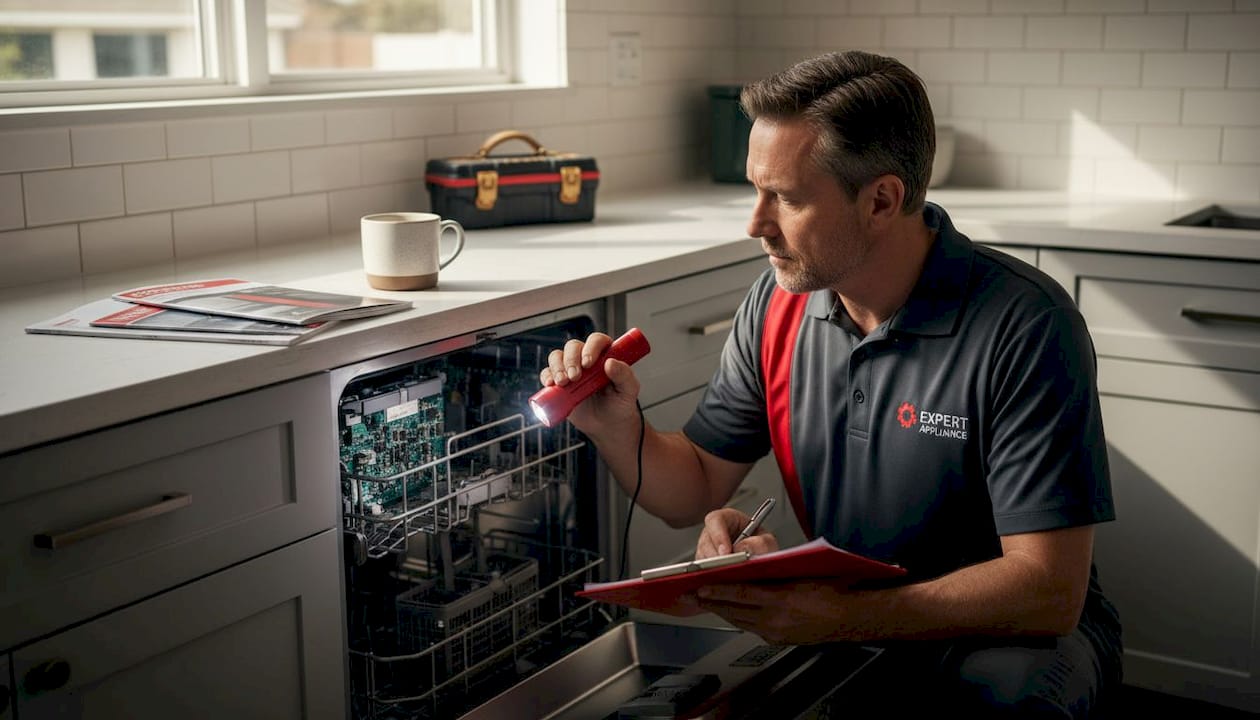
Your refrigerator suddenly stops cooling. Your washer freezes mid-cycle for no obvious reason. Your oven throws a strange error code and refuses to heat. Most homeowners in Marlboro, NJ immediately assume a motor burned out or a simple part broke. But in many cases, the real culprit is far less obvious: the circuit board, often called the control board or PCB (printed circuit board). This tiny component is the brain of your appliance, and when it fails, the symptoms can be confusing, random, and even dangerous. Understanding how circuit boards work, how they fail, and how professionals diagnose them will save you time, money, and frustration.
Table of Contents
- What does a circuit board do in your appliance?
- Common signs of circuit board failure
- How technicians diagnose circuit board problems
- Preventing and managing circuit board issues
- Why misdiagnosis is the #1 cause of wasted appliance expenses
- Protect your appliances and get expert help
- Frequently asked questions
Key Takeaways
| Point | Details |
|---|---|
| Circuit boards are the brains | They control all logic and advanced features in today’s home and business appliances. |
| Failure signs may be subtle | Circuit board issues can cause erratic, random appliance problems or show physical damage signs. |
| Skilled diagnosis saves money | A step-by-step diagnostic approach prevents costly, unnecessary board replacements. |
| Prevention is crucial | Using surge protectors, correcting wiring, and regular checks help avoid costly failures. |
| Safety comes first | Never keep using an appliance with signs of board damage or burning—call a pro right away. |
What does a circuit board do in your appliance?
Modern appliances are far more complex than they were 30 years ago. Today’s washers, refrigerators, ovens, and dishwashers are built around a central circuit board that manages virtually everything the machine does. Think of it like the main control panel in an airplane cockpit. Every button press, sensor reading, and safety interlock passes through this board before anything happens.
In plain English, a circuit board (also called a control board or PCB) is a flat panel covered with tiny electronic components, resistors, capacitors, and microprocessors that receive input signals and send output commands. When you press “Start” on your washer, the circuit board interprets that signal and tells the motor, water valve, and heating element exactly what to do and when.
Here are the core functions a circuit board handles across common household appliances:
- Control logic and sequencing: The board decides the correct order of operations, like when to fill with water before spinning or when to preheat before baking.
- Sensor monitoring: It constantly reads temperature sensors, pressure switches, and float sensors to adjust performance in real time.
- Safety interlocks: The board shuts down the appliance if it detects overheating, overflow, or a door left open, protecting you and your home.
- Error code generation: When something goes wrong, the board logs the problem and displays a code, making diagnosis far easier for a qualified technician.
- Energy management: Modern boards regulate power consumption to maximize efficiency, which is why new appliances use less electricity while doing more.
You can learn more about how to spot appliance problems before they escalate into costly repairs. Getting familiar with your appliance’s behavior is one of the best early warning systems you have.
| Appliance | Key circuit board functions |
|---|---|
| Refrigerator | Temperature control, defrost cycle timing, compressor regulation, ice maker logic |
| Washer | Cycle sequencing, water level sensing, motor speed control, spin timing |
| Dryer | Heat regulation, moisture sensing, cycle timing, safety thermostat monitoring |
| Oven / range | Temperature calibration, bake/broil control, timer logic, safety shutoff |
| Dishwasher | Wash cycle sequencing, water fill control, heating element regulation, drain timing |
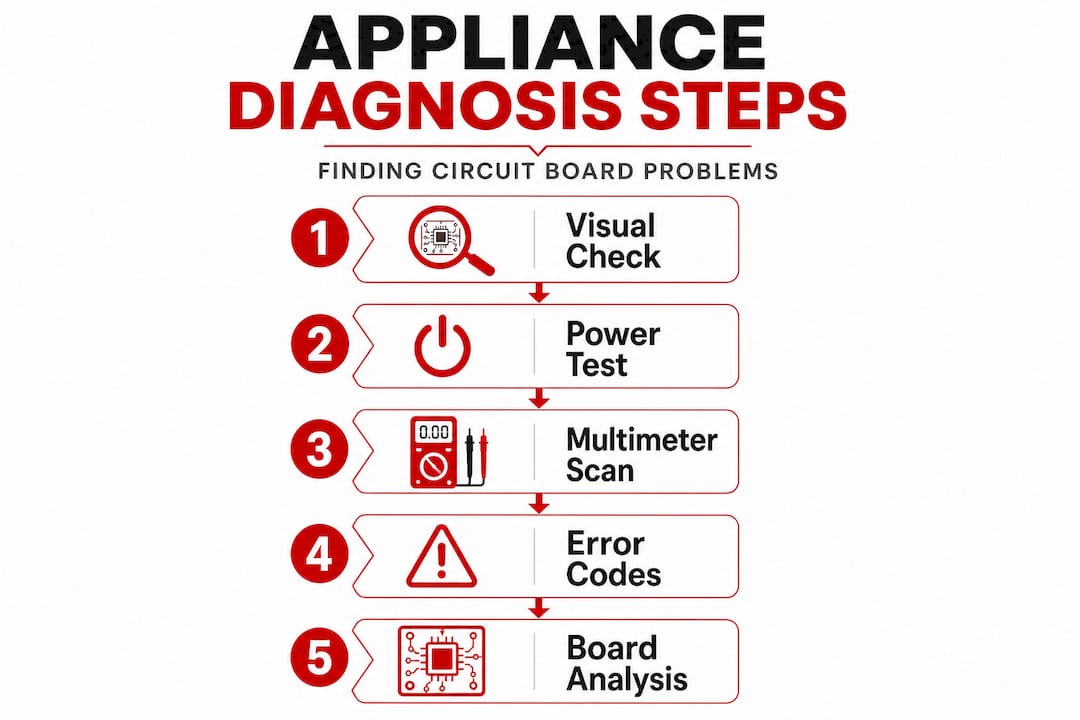
Technicians who suspect a board issue will use a methodical approach: visual inspection, multimeter testing, and error code analysis before moving to advanced tools like thermal imaging cameras or oscilloscopes to trace electrical signals. Knowing this helps you understand why a proper diagnosis takes time and expertise.
Common signs of circuit board failure
Knowing the purpose of the circuit board is just the first step. Knowing the warning signs of imminent failure is just as crucial, because acting early can prevent a minor problem from becoming a dangerous one.
Circuit board failures do not always announce themselves dramatically. Sometimes the signs are subtle, random, or easy to confuse with other problems. Here are the most common symptoms that suggest your appliance’s brain may be compromised:
- Erratic or inconsistent operation: Your washer randomly stops mid-cycle, your oven temperature swings wildly, or your refrigerator runs constantly without explanation.
- Appliance completely dead: Pressing buttons or turning dials produces no response, yet power is confirmed at the outlet.
- Unexplained error codes: The display shows codes that do not match any obvious mechanical problem, or the same code keeps returning after being cleared.
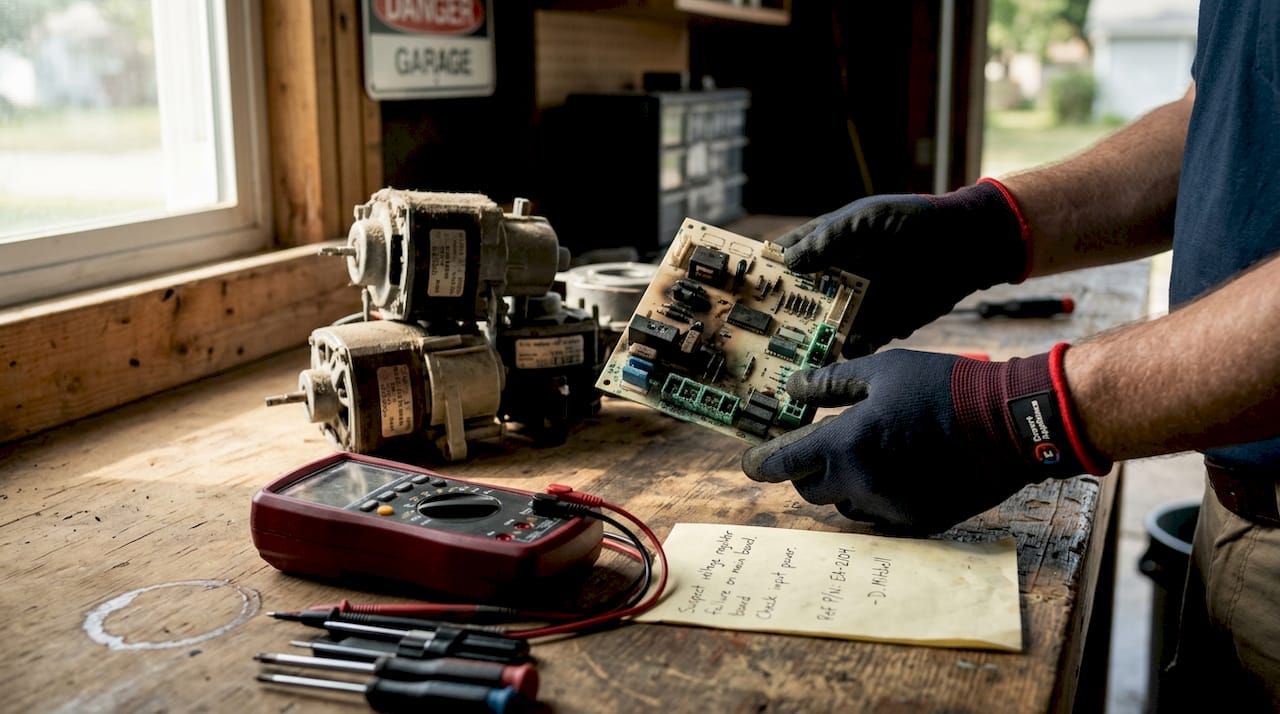
- Burnt smell or visible burn marks: A sharp electrical odor, or blackened spots on the board itself, is a serious red flag.
- Buttons or controls that stop responding: The keypad registers nothing, or only certain functions work while others do not.
- Lights flickering or displays acting strangely: Random display glitches, frozen screens, or incorrect readouts often trace back to board failures.
Pay close attention to physical warning signs. Burn marks, melted connectors, or a smell like burnt insulation means the board has suffered heat damage, and continuing to run the appliance may create a fire or electrical hazard. At that point, the appliance should be shut off immediately.
“Control boards can show burn marks, melted connectors, or burnt insulation smell when damaged; in those cases, using the appliance may be unsafe and replacement or qualified diagnostics are commonly recommended.” — ApplianceCodeHub
Understanding the link between appliance short circuit causes and board damage can help you prevent the next failure. Voltage spikes, water infiltration, and overheated components are frequent culprits.
Pro Tip: If you notice a burnt smell and your appliance suddenly stops working, do not keep trying to restart it. Continued cycling can worsen the damage and create a safety risk. Unplug the unit immediately and call a technician before using it again.
Homeowners in Monmouth County often find that the symptoms they experience are listed in this appliance troubleshooting guide, which breaks down common failure patterns by appliance type. It is a useful reference when you are trying to describe the problem to a repair professional.
How technicians diagnose circuit board problems
When symptoms suggest your appliance’s brain has failed, how do experts confirm it? The diagnostic process is far more involved than simply pulling the board and ordering a replacement. Skipping steps is one of the biggest and most expensive mistakes a homeowner or underqualified technician can make.
Here is the step-by-step process that qualified technicians follow:
- Confirm the basics first. Check that power is reaching the appliance, breakers have not tripped, and the outlet is functioning correctly. Many “board problems” turn out to be a tripped breaker or loose power connection.
- Inspect for physical damage. The technician removes access panels and looks closely at the board for burn marks, corrosion, melted solder joints, or swollen capacitors. These are visible signs that the board has already failed.
- Retrieve and interpret error codes. Most modern appliances store fault codes in memory. A technician pulls these codes using the appliance’s built-in diagnostic mode or a service tool, then cross-references them with the manufacturer’s service charts.
- Use a multimeter to test electrical signals. A multimeter measures voltage, resistance, and continuity at the board’s input and output terminals. This confirms whether the board is receiving correct signals and sending appropriate commands.
- Advanced testing when needed. For complex or intermittent faults, technicians may use thermal imaging cameras to spot overheating components that are invisible to the naked eye, or an oscilloscope to analyze signal waveforms. These advanced diagnostic approaches identify problems that basic testing can miss entirely.
Here is a practical comparison of what homeowners can safely check themselves versus what requires professional tools and expertise:
| Check | DIY possible? | Professional tool needed? |
|---|---|---|
| Power at outlet | Yes (simple outlet tester) | No |
| Tripped breaker | Yes | No |
| Visible burn marks (external) | Yes (visual check) | No |
| Error code retrieval | Sometimes (owner’s manual) | Often (service tool) |
| Multimeter electrical testing | Only with training | Yes (multimeter) |
| Thermal imaging scan | No | Yes (infrared camera) |
| Oscilloscope waveform analysis | No | Yes (oscilloscope) |
Proper diagnosing of appliances means treating the circuit board as one part of the overall system, not as the automatic answer. A technician who jumps straight to board replacement without testing inputs, outputs, sensors, and wiring connections first is guessing, not diagnosing. And guessing is expensive.
Understanding the full appliance service workflow gives you a better picture of what a good repair call should look like from start to finish.
Preventing and managing circuit board issues
Knowing how the pros diagnose boards is empowering, but it is even better to prevent issues before disaster strikes or minimize the impact when they do occur. There are several practical steps every homeowner and small business owner in Marlboro, NJ can take to protect their appliances.
- Install surge protectors. Power surges from storms, utility switching, or other appliances on the same circuit can fry a control board instantly. A quality surge protector on your washer, refrigerator, or dishwasher is inexpensive insurance.
- Address moisture and leaks immediately. Water is one of the most destructive forces for circuit boards. If your dishwasher leaks internally or your washer has a slow drip, get it repaired before moisture reaches the electronics.
- Keep vents and filters clean. Blocked airflow causes heat to build up inside the appliance. Heat is the second biggest destroyer of circuit boards, stressing components until they fail prematurely.
- Avoid overloading appliances. Running machines beyond their rated capacity forces the board to manage electrical loads it was not designed to handle continuously.
- Schedule routine inspections. An annual checkup by a qualified technician can catch early signs of wear, corrosion, or wiring issues before they escalate to full board failure.
One of the most practical pieces of advice for any homeowner is this: before assuming a bad board, treat the appliance as a system. Verify power at the outlet, check breaker positions, look for loose wiring connections, and note any error codes. Random or intermittent symptoms often trace back to something simpler than a failed board, and careful isolation prevents misdiagnosis.
Pro Tip: If an appliance starts behaving erratically, stop using it and make a note of exactly what happened, when it happened, and what error code appeared if any. That information is gold for a technician and speeds up the diagnosis considerably, which keeps your repair bill lower.
It is also worth understanding when a repair is practical versus when replacement is the smarter financial move. If a board replacement costs more than 50% of the appliance’s current market value, and the appliance is older than 10 years, replacement of the entire unit is often the better investment. A good technician will give you honest guidance on this, not just push for the higher repair ticket.
Reviewing common appliance troubleshooting tips before you call for service helps you rule out simple causes and communicate clearly with your technician.
Why misdiagnosis is the #1 cause of wasted appliance expenses
After 35 years of serving homeowners in Marlboro and across Monmouth County, we have seen one pattern repeat itself more than any other: the rushed diagnosis. A technician arrives, sees a dead appliance, swaps the circuit board, and leaves. Two weeks later, the appliance fails again. Why? Because the real problem was never the board.
Consider a scenario we have encountered many times. A homeowner’s refrigerator stops cooling. A quick board replacement is ordered and installed. But the actual cause was a failing temperature sensor sending bad data to an otherwise functioning board. The new board interprets the same bad sensor signal the same way the old one did, and the cooling problem returns. Now the homeowner has paid for a board they did not need and still has a broken refrigerator.
This is the “board swap” culture at its worst. Without systematic testing, you are just replacing parts and hoping one of them sticks. That approach costs homeowners hundreds of dollars unnecessarily every year. The right repair process treats the board as a suspect, not a certainty, until testing confirms it is the actual source of the problem.
Here is the uncomfortable truth: a good technician who takes 30 extra minutes to test sensors, wiring, and input signals will almost always save you money compared to one who replaces the most expensive component first. Careful isolation before replacing parts is not just best practice, it is the difference between a solved problem and a costly repeat service call.
Our advice is straightforward. When you call for appliance repair, ask the technician to walk you through what they tested and what eliminated each possible cause. If they cannot explain their reasoning, that is a red flag. The best technicians welcome that question because their process holds up to scrutiny.
Protect your appliances and get expert help
Circuit board diagnostics require more than a replacement part and a screwdriver. They require experience, the right tools, and a systematic approach that treats your appliance as a complete system rather than a list of replaceable components.

At Expert Appliance Repair, we have been serving homeowners and small businesses in Marlboro, NJ and throughout Monmouth County since 1988. We work on all major brands and appliance types, from refrigerators and washers to ovens, dryers, and dishwashers. If your appliance is behaving strangely, throwing error codes, or showing signs of board damage, our technicians are ready to diagnose it correctly the first time. We offer same-day service, 24/7 emergency appliance repair, and upfront pricing with no surprises. Browse the full list of appliance brands we repair and learn how our appliance maintenance tips can help you avoid expensive breakdowns before they happen.
Frequently asked questions
Why do modern appliances rely so heavily on circuit boards?
Circuit boards provide the precision control and automation that allows today’s appliances to run efficiently, respond to sensor data in real time, and deliver advanced features that older mechanical systems simply cannot match.
Are circuit board failures usually repairable or do they always require replacement?
Some issues like minor corrosion or a single failed component can sometimes be repaired, but burn marks or melted connectors indicate heat damage serious enough that full board replacement is the safer and more reliable option.
Is it safe to use an appliance with a suspected circuit board problem?
No. Burn marks, melted connectors, or a burnt smell are signs of potential fire or electrical hazard, and the appliance should be unplugged immediately and left off until a qualified technician inspects it.
What can homeowners do to prevent circuit board failure?
Use surge protectors, fix leaks and moisture problems right away, keep vents clear for proper airflow, avoid overloading appliances, and schedule annual maintenance checks to catch early warning signs before they become costly failures.
How do technicians know the board is the real problem and not something else?
They follow a systematic process: verifying power, checking for physical damage, pulling error codes, and using multimeter testing and advanced tools like thermal cameras and oscilloscopes to isolate the board as the confirmed source before any part is replaced.