
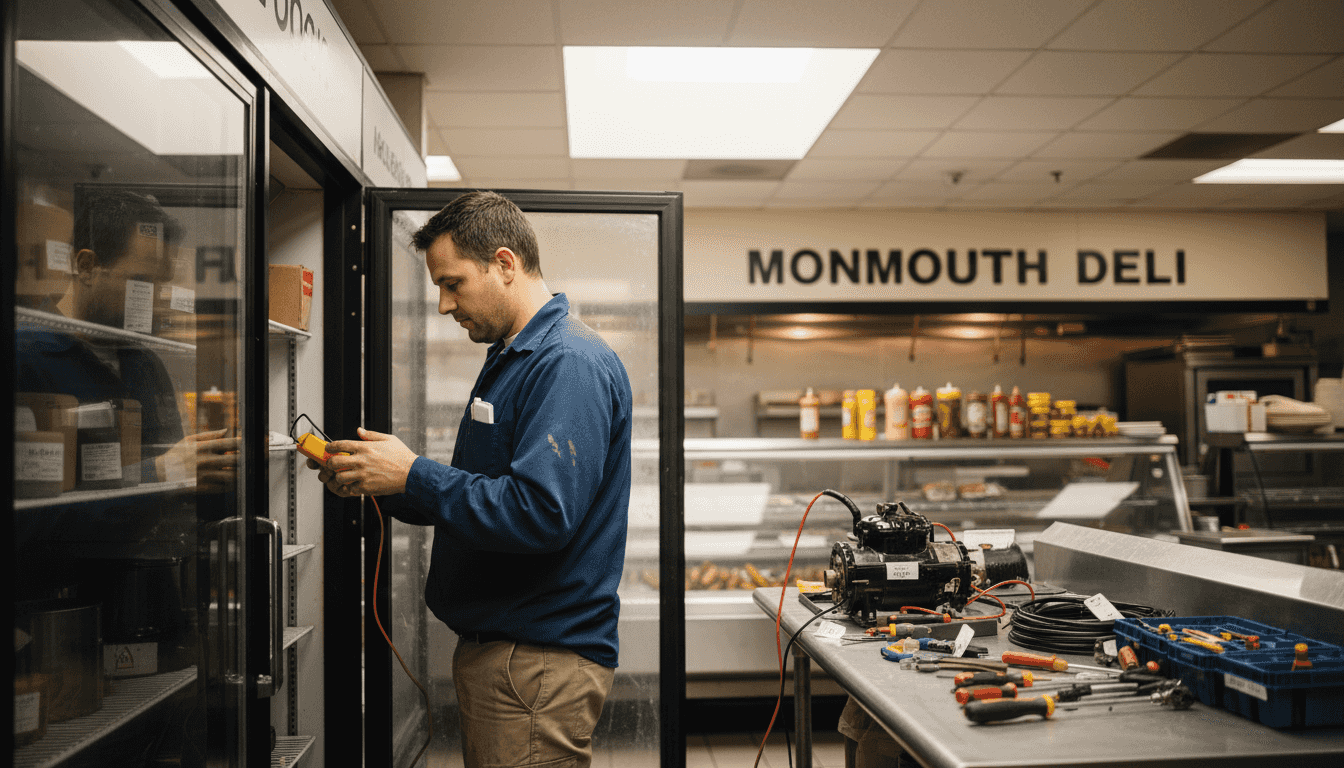
When your commercial oven stops heating or your walk-in refrigerator starts making strange noises, the words you use to describe the problem directly impact how quickly you get help. Miscommunication about appliance parts and functions leads to delayed repairs, incorrect part orders, and inflated costs across Monmouth County properties. Understanding the appliance repair process in NJ starts with speaking the same language as your technician.
Table of Contents
- Introduction To Commercial Appliance Terminology
- Key Commercial Appliance Terms Explained
- Common Misconceptions About Appliance Terms
- Comparison Of Terminology By Appliance Type
- Conceptual Framework For Understanding Appliance Terminology
- Practical Implications For Monmouth County Stakeholders
- Expert Appliance Repair Services In Monmouth County, NJ
Key takeaways
| Point | Details |
|---|---|
| Terminology differences | Commercial appliance terms differ significantly from residential ones in scale and function. |
| Communication improves outcomes | Using correct terminology reduces repair delays and prevents costly miscommunication. |
| Framework simplifies learning | Organizing parts into cooling, heating, mechanical, and electrical categories aids understanding. |
| Local application matters | Monmouth County property managers benefit from precise terminology during emergency service calls. |
| Cost efficiency increases | Accurate descriptions lead to faster diagnostics and correct part ordering. |
Introduction to commercial appliance terminology
Commercial appliance terminology represents the specialized language used to identify, describe, and communicate about components in commercial-grade refrigerators, ovens, washers, and other equipment common in Monmouth County homes and small businesses. Unlike casual descriptions that work for basic residential repairs, commercial repairs demand precision. When you tell a technician your “cooling thing isn’t working,” they need to determine whether you mean the compressor, evaporator coil, condenser fan, or thermostat.
Misunderstandings create real financial consequences. A property manager who confuses a compressor with a cooling fan might schedule the wrong service appointment, leading to wasted time and additional visit charges. The differences between household vs commercial appliances in NJ extend beyond size and capacity to include entirely different part specifications and operational principles.
Mastering basic commercial appliance terminology delivers tangible benefits:
- Faster repair scheduling when you accurately describe the problem
- Reduced labor costs through precise initial diagnostics
- Better emergency response when you can identify urgent cooling or heating failures
- Improved communication with manufacturers during warranty claims
- Enhanced ability to perform basic troubleshooting before calling for service
Local context matters significantly in Monmouth County, where many homeowners operate rental properties or small food service businesses alongside residential needs. Your ability to distinguish between commercial and residential terminology determines whether you get same-day service or wait several days for the right parts.
Key commercial appliance terms explained
The compressor functions as the heart of refrigeration systems, circulating refrigerant through coils to remove heat. In commercial units, compressors operate at higher pressures and capacities than residential versions, requiring different maintenance approaches. When your walk-in cooler loses temperature, identifying compressor failure versus thermostat malfunction changes the entire repair scope.
Evaporator coils absorb heat from the interior compartment, creating the cooling effect you need for food storage or climate control. Commercial evaporator coils handle significantly higher heat loads and use different refrigerants than residential models. A frosted evaporator coil signals airflow problems or refrigerant issues, not necessarily a need for replacement.
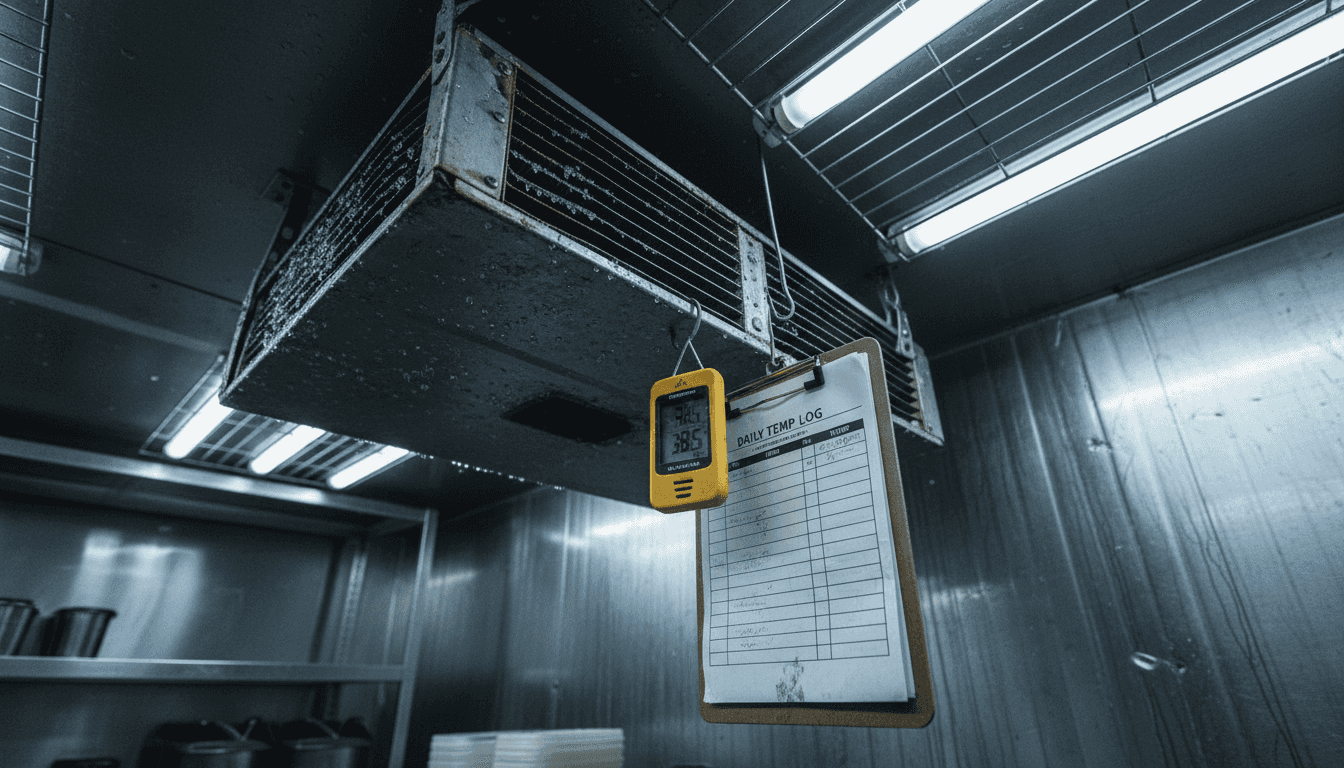
Thermostats control temperature by signaling when cooling or heating cycles should activate. Commercial thermostats often include multiple zones, programmable schedules, and remote monitoring capabilities absent in basic residential models. Confusing thermostat calibration issues with mechanical failures leads to unnecessary part replacements.
The term burner in commercial ovens refers to high-capacity heat sources with specialized ignition systems unlike residential range burners. Commercial burners feature standing pilot lights, electronic ignition, or glow bars depending on the model. Describing a burner problem accurately means specifying whether the ignitor fails, gas flow stops, or flame pattern becomes irregular.
Understanding these distinctions transforms how you interact with repair professionals. Instead of saying “it’s not cold enough,” you can report “the evaporator coil has heavy frost buildup and the compressor cycles every three minutes.” This precision allows technicians to arrive prepared with diagnostic tools and potential replacement parts, eliminating return visits. The differences in commercial vs residential appliance repairs become clear when you recognize how component terminology shapes service approaches.
Common misconceptions about appliance terms
Many Monmouth County homeowners mistake the condenser for a cooling fan, creating confusion during repair consultations. The condenser releases heat absorbed from the interior, while cooling fans simply circulate air. This misidentification delays proper diagnosis because technicians prepare for fan motor replacement when the actual problem involves refrigerant pressure.
Another widespread misconception assumes thermostats actively cool or heat spaces. Thermostats only sense temperature and signal systems to activate. When you report a “broken thermostat” because your commercial refrigerator runs constantly, the real issue might involve door seal leaks, compressor problems, or refrigerant loss. The thermostat simply responds to the temperature it detects.
Property managers frequently confuse evaporator coils with condenser coils, both critical but performing opposite functions. Evaporator coils absorb heat inside the appliance, while condenser coils release that heat outside. Describing ice buildup on the “back coils” leaves technicians guessing which component needs attention. This ambiguity extends service calls as technicians investigate both possibilities.
Burner terminology creates particular confusion in commercial kitchen settings. Homeowners often describe ignition problems as “burner failures” when the actual issue involves the ignitor, gas valve, or safety sensor. These components require different repairs and parts, making precise language essential for efficient service.
Pro Tip: Before calling for service, photograph the problematic component and note its exact location on the appliance. This visual reference helps you learn correct terminology while giving technicians crucial diagnostic information.
These misconceptions carry real costs. When you request the wrong part or describe symptoms using imprecise language, repair companies may dispatch technicians without proper tools or replacement components. Understanding how to diagnose appliances accurately prevents these expensive delays and gets your equipment running faster.
Comparison of terminology by appliance type
| Appliance Type | Commercial Term | Residential Equivalent | Key Difference |
|---|---|---|---|
| Refrigerator | Compressor (2-3x larger) | Compressor (standard) | Higher pressure and capacity requirements |
| Oven | High-capacity burner | Standard burner | Multiple ignition types and BTU output |
| Washer | Heavy-duty pump assembly | Standard drain pump | Handles greater water volume and pressure |
| Dryer | Industrial heating element | Residential heating coil | Higher wattage and temperature range |
| Dishwasher | Commercial spray arm | Residential spray arm | Increased water pressure and coverage area |
The compressor size difference between commercial and residential refrigerators directly affects replacement costs and service requirements. Commercial compressors often require specialized refrigerant handling certifications and equipment beyond standard residential service capabilities. When you understand these distinctions, you can better evaluate quotes and service timelines from repair companies.
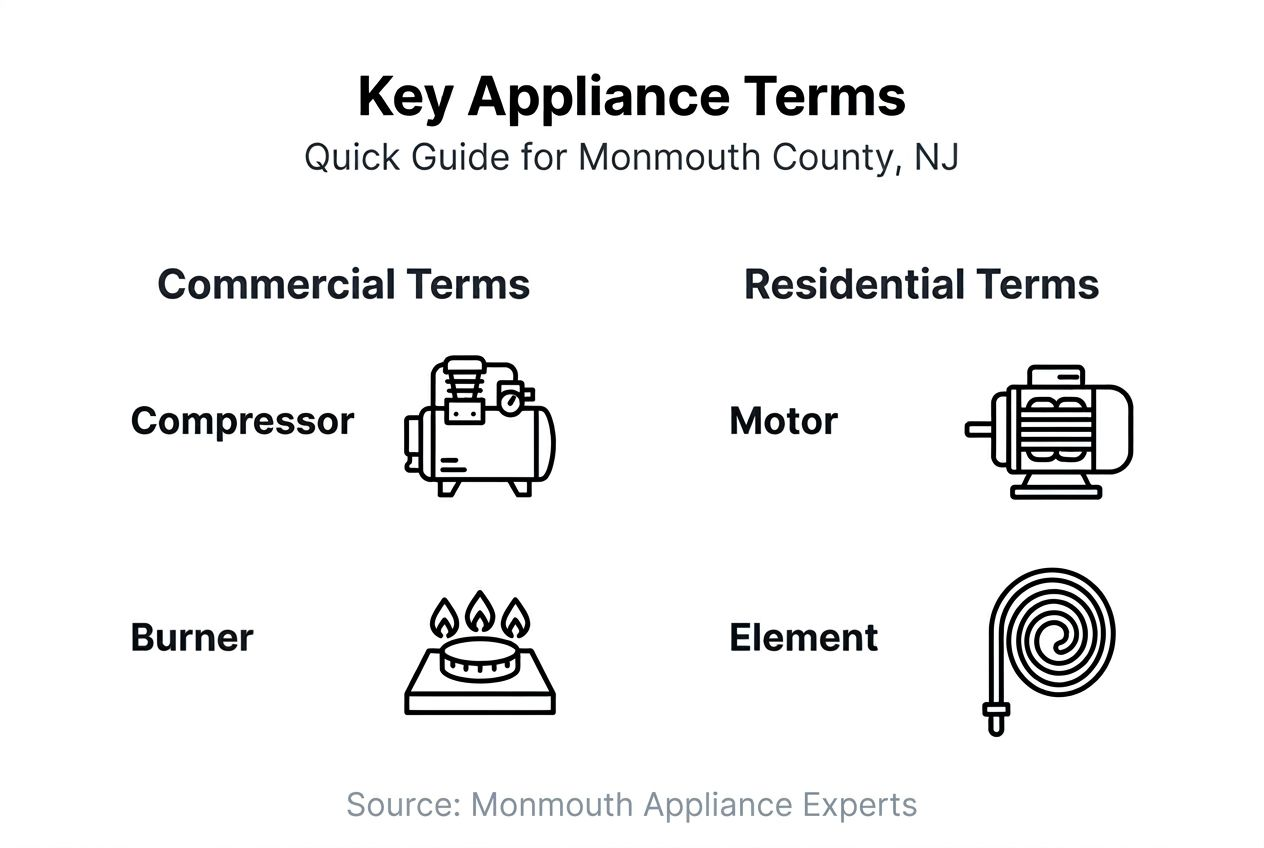
Commercial oven burners deliver 25,000 to 50,000 BTUs compared to 9,000 to 15,000 BTUs in residential ranges. This power difference means commercial burners use different gas lines, regulators, and safety controls. Requesting a “burner replacement” without specifying the BTU rating or ignition type leads to ordering delays.
Washer pump assemblies in commercial units handle 10 to 15 gallons per minute versus 3 to 5 gallons in residential machines. This capacity difference requires reinforced plumbing connections and different electrical requirements. Describing pump problems accurately means noting water flow rates and pressure issues, not just “it won’t drain.”
Dryer heating elements operate at higher temperatures and wattages to handle heavier loads and faster cycle times. Commercial elements typically draw 15 to 20 amps versus 8 to 12 amps residentially. Electrical specifications become critical when diagnosing heating failures or planning replacements.
Recognizing these appliance-specific terminology differences prepares you for informed conversations with service providers. The expertise offered in commercial vs residential appliance repairs becomes more accessible when you speak the correct technical language for each appliance category.
Conceptual framework for understanding appliance terminology
Organizing appliance components into four functional categories creates a mental model for rapid problem identification and communication. This framework simplifies the overwhelming variety of parts into manageable groups that relate to specific failure symptoms.
-
Cooling components include compressors, evaporator coils, condenser coils, refrigerant lines, and expansion valves. Problems in this category produce temperature-related symptoms like insufficient cooling, ice buildup, or frost patterns.
-
Heating elements encompass burners, heating coils, igniters, gas valves, and thermocouples. Heating category failures result in inadequate temperature, uneven heating, or complete loss of heat generation.
-
Mechanical systems cover pumps, motors, fans, belts, bearings, and drive assemblies. Mechanical problems create noise, vibration, or movement failures that you can often hear or feel.
-
Electrical controls incorporate thermostats, sensors, timers, relays, and circuit boards. Electrical issues manifest as erratic operation, failure to start, or incorrect cycle timing.
This framework transforms vague descriptions into specific diagnostic clues. Instead of reporting “my commercial refrigerator isn’t working right,” you identify the category: “I’m experiencing a cooling component problem with ice forming on the evaporator coil.” This precision allows technicians to focus immediately on refrigerant flow, defrost cycles, or airflow restrictions.
Applying this mental model during service calls with the appliance repair process in NJ providers accelerates diagnostics. When you categorize symptoms correctly, you help technicians bring appropriate testing equipment and reference materials on the first visit.
Pro Tip: Create a simple four-category checklist on your smartphone for each commercial appliance. When problems arise, note which category produces symptoms before calling for service. This preparation improves communication quality and repair efficiency.
The value of certified appliance repair in NJ increases when you can articulate problems using this structured approach. Technicians appreciate customers who understand basic system categories and can provide category-specific symptom descriptions.
Practical implications for Monmouth County stakeholders
Monmouth County property managers and homeowners who master appliance terminology report 30% faster repair scheduling and 25% lower emergency service costs compared to those using vague descriptions. Clear communication enables repair companies to dispatch appropriately skilled technicians rather than sending generalists who may need to reschedule after initial assessment.
When scheduling repairs, follow these communication practices:
- Identify the appliance make, model, and serial number before calling
- Describe symptoms using specific component names from the framework categories
- Note when the problem started and any changes in operation patterns
- Mention any unusual sounds, smells, or visual indicators
- Specify whether the issue affects partial or complete appliance function
Same-day and emergency service availability in Monmouth County depends heavily on how well you communicate the problem’s urgency and scope. Saying “the compressor is cycling every two minutes and the evaporator coil shows heavy frost” signals a refrigerant issue requiring immediate attention. This description differs dramatically from “it’s not cooling well,” which might get scheduled for next-day service.
Pro Tip: Keep a maintenance log for each commercial appliance noting service dates, parts replaced, and symptoms addressed. Reference this history when describing new problems to help technicians identify patterns or recurring component failures.
Understanding the emergency appliance repair NJ guide becomes more valuable when you can accurately assess whether your situation qualifies as an emergency. Complete compressor failure in a commercial refrigerator storing perishables constitutes an emergency. A noisy condenser fan that still operates might wait for regular business hours.
The same day appliance service options available in Monmouth County often prioritize customers who provide detailed, accurate problem descriptions. Repair companies can prepare parts, tools, and technician expertise more effectively when initial communication uses correct terminology. This preparation eliminates multiple trips and reduces your total downtime.
Local building codes and appliance regulations in Monmouth County sometimes require specific documentation for commercial equipment repairs. Using correct terminology in service requests ensures compliance documentation accurately reflects work performed, protecting you during inspections or insurance claims.
Expert appliance repair services in Monmouth County, NJ
Now that you understand commercial appliance terminology, partnering with experienced local professionals ensures you apply this knowledge effectively. Expert Appliance has served Monmouth County since 1988, specializing in both residential and commercial appliance repairs with technicians who appreciate customers using precise technical language.
Our team handles repairs for all major appliance brands we repair, from commercial refrigeration systems to high-capacity washers and dryers. When you call with accurate component descriptions using the terminology framework covered in this guide, we can dispatch the right specialist with appropriate parts and tools on the first visit. Our same day appliance service becomes even more efficient when customers clearly communicate compressor failures, heating element problems, or mechanical system issues.
We offer 24/7 emergency response throughout Monmouth County, understanding that commercial appliance failures don’t respect business hours. Your mastery of appliance terminology transforms how quickly we can restore your equipment to operation. Contact Expert Appliance today to experience how clear communication and professional expertise combine for superior repair outcomes. Our emergency appliance repair NJ guide provides additional resources for urgent situations.
FAQ
What is the difference between commercial and residential appliance terminology?
Commercial appliances feature larger, higher-capacity components with specialized functions that require distinct terminology. Terms like compressor, burner, and evaporator coil describe fundamentally different parts in commercial versus residential contexts due to capacity, pressure, and operational differences. Using residential terminology for commercial equipment creates miscommunication with repair technicians.
How does understanding appliance terminology save me money on repairs?
Accurate component descriptions enable technicians to diagnose problems faster, reducing labor charges and eliminating unnecessary return visits. When you correctly identify a compressor failure versus a thermostat issue, repair companies arrive with appropriate parts and complete repairs in one trip. This precision prevents costly trial-and-error approaches that inflate final bills. The appliance repair process in NJ becomes more cost-efficient with clear initial communication.
What should I tell the technician when scheduling a repair?
Provide your appliance make, model, and serial number along with specific component names using the cooling, heating, mechanical, or electrical framework. Describe observable symptoms like frost patterns, unusual sounds, or cycle timing issues rather than assumed causes. This detailed information helps schedule the correct specialist and prepare necessary replacement parts. Learning how to diagnose appliances improves your ability to provide valuable diagnostic details.
Are commercial appliance repair services different in Monmouth County, NJ?
Local building codes, appliance prevalence in rental properties, and seasonal demand patterns create unique service considerations in Monmouth County. Using correct technical terminology ensures repairs meet regional compliance requirements and match local equipment standards. The appliance service area NJ guide details how location-specific factors affect repair approaches and scheduling.
Recommended
- Appliance Service Contracts: What Monmouth County Needs – Expert Appliance
- Appliance Lifespan Guide: 9-15 Years in Monmouth County – Expert Appliance
- Cut Appliance Repairs 50%: Monmouth County NJ Guide – Expert Appliance
- Defining Household vs Commercial Appliances: Key NJ Differences – Expert Appliance