
When your refrigerator grinds to a halt or your oven refuses to heat up, the last thing you want is confusion about what kind of repair you need. For Marlboro, New Jersey homeowners, knowing how to quickly tell the difference between a standard household appliance and a commercial-grade unit can make all the difference when every minute counts. With appliance durability and energy efficiency standards affecting both types, this guide will help you spot the key distinctions so you can get the right repairs fast and restore your home’s routine.
Table of Contents
- What Sets Household and Commercial Appliances Apart
- Major Types of Appliances and Core Differences
- Key Design, Performance, and Usage Characteristics
- Legal Standards and NJ Compliance Requirements
- Risks, Costs, and Repair Needs for Homeowners
Key Takeaways
| Point | Details |
|---|---|
| Difference in Usage | Household appliances are designed for family use, while commercial ones handle high-volume operations. |
| Durability and Performance | Commercial appliances are built for rigorous use, emphasizing durability and continuous operation. |
| Design Philosophy | Residential devices focus on aesthetics and user-friendliness, in contrast, commercial units prioritize raw performance and reliability. |
| Financial Considerations | Homeowners should evaluate both initial costs and long-term maintenance to ensure efficient appliance ownership. |
What Sets Household and Commercial Appliances Apart
Household and commercial appliances might seem similar at first glance, but critical differences define their design, performance, and functionality. Understanding these distinctions helps consumers and business owners make informed decisions about their equipment needs. Energy conservation standards play a significant role in highlighting these unique characteristics.
The primary differences between household and commercial appliances emerge in several key areas:
- Scale of Use: Household appliances are designed for smaller, family-level consumption, while commercial units handle high-volume, intensive operations
- Durability: Commercial appliances feature more robust construction to withstand constant, rigorous use
- Energy Efficiency: Both types are subject to national energy standards, but with different performance expectations
- Size and Capacity: Commercial units typically offer larger dimensions and greater processing capabilities
Business environments demand appliances that can operate continuously and manage substantially higher workloads compared to residential settings. A commercial refrigerator, for instance, must maintain precise temperatures while storing significantly more inventory than a home refrigerator. These units are engineered with industrial-grade components that can endure constant stress and frequent usage cycles.
The design philosophy also diverges substantially between household and commercial appliances. Residential devices prioritize aesthetic integration, energy conservation, and user-friendly interfaces. Commercial appliances, conversely, emphasize raw performance, rapid processing, and minimal downtime. Durability becomes paramount in commercial settings where equipment failure can translate directly into lost productivity and revenue.
Pro tip: When selecting an appliance, always consider your specific usage requirements and prioritize performance metrics that align with your intended environment.
Major Types of Appliances and Core Differences
Home and commercial appliances encompass a wide range of equipment designed to serve different functional needs across residential and professional environments. Major appliances, often called white goods, include critical categories that span multiple usage contexts and performance requirements.
The primary types of household and commercial appliances can be categorized into several key groups:
- Refrigeration Units
- Residential: Compact, energy-efficient models for family food storage
- Commercial: Large-capacity units for restaurants, supermarkets, and industrial kitchens
- Cooking Equipment
- Residential: Standard ranges, ovens, and cooktops for home meal preparation
- Commercial: Industrial-grade stoves, griddles, and high-volume cooking systems
- Laundry Machines
- Residential: Standard washers and dryers for family use
- Commercial: Heavy-duty, continuous-cycle machines for hotels, hospitals, and laundromats
- Cleaning Appliances
- Residential: Dishwashers designed for household kitchen needs
- Commercial: Industrial dishwashers with rapid cleaning and sanitization cycles
Each appliance category demonstrates significant variations between household and commercial designs. Residential devices prioritize aesthetic integration, energy conservation, and user-friendly interfaces. Commercial appliances, by contrast, emphasize raw performance, durability, and capacity to handle continuous, high-intensity operations.
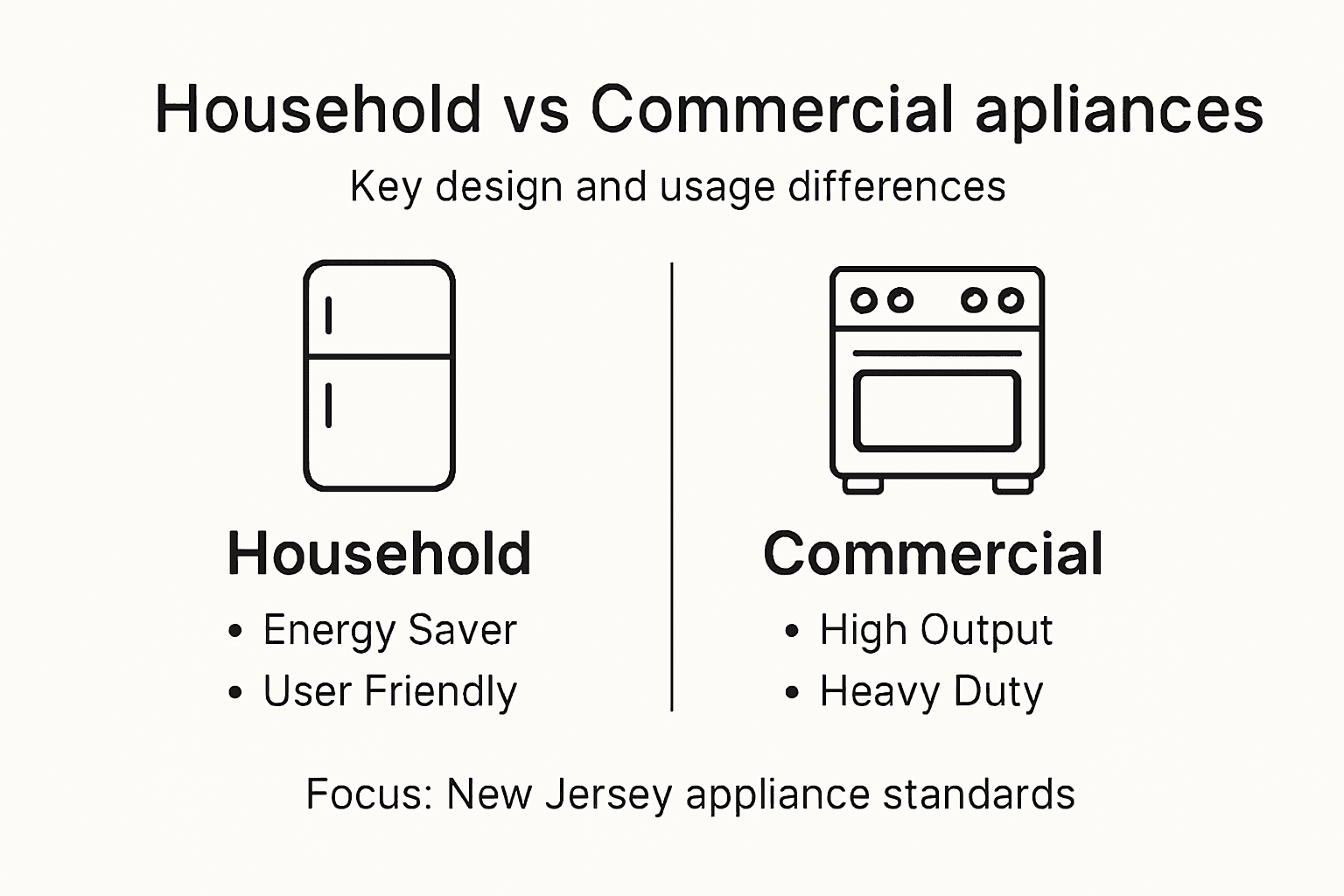
Here’s how major appliance categories compare in residential versus commercial settings:
| Appliance Type | Residential Focus | Commercial Focus |
|---|---|---|
| Refrigeration Units | Family food preservation | Bulk inventory management |
| Cooking Equipment | Home meal preparation | High-volume, rapid cooking |
| Laundry Machines | Occasional family loads | Continuous heavy-duty cycles |
| Cleaning Appliances | Kitchen convenience | Fast sanitization, large scale |
Technological advancements have further widened the gap between household and commercial appliances. Modern commercial units incorporate sophisticated monitoring systems, industrial-grade components, and specialized features that far exceed the capabilities of standard home appliances. These differences reflect the unique demands of business environments where equipment reliability directly impacts operational efficiency.
Pro tip: When selecting appliances for any environment, carefully assess the specific performance requirements, usage frequency, and long-term durability needs to make the most appropriate choice.
Key Design, Performance, and Usage Characteristics
Appliance design and performance vary dramatically between household and commercial environments, driven by fundamentally different operational requirements. Newer appliances demonstrate significant technological evolution that highlights the sophisticated engineering behind modern equipment.
Key performance characteristics differentiate household and commercial appliances across multiple dimensions:
- Design Complexity
- Household: Aesthetically pleasing, compact, energy-efficient
- Commercial: Robust, utilitarian, designed for maximum durability
- Performance Metrics
- Residential: Intermittent use, lower capacity, consumer-friendly interfaces
- Commercial: Continuous operation, high-volume processing, specialized controls
- Material Construction
- Home Appliances: Cost-effective materials, lighter components
- Business Appliances: Industrial-grade metals, reinforced structural elements
- Technological Integration
- Residential: Basic monitoring, user-friendly digital interfaces
- Commercial: Advanced diagnostic systems, real-time performance tracking
The fundamental engineering philosophy diverges significantly between household and commercial appliances. Residential devices prioritize energy conservation, aesthetic appeal, and affordability, while commercial units emphasize raw performance, durability, and reliability under constant stress. This distinction means commercial refrigerators, for instance, use more powerful compressors and thicker insulation to maintain consistent temperatures during extended operational periods.
Technological advances continue to drive innovation in appliance design, with manufacturers developing increasingly sophisticated solutions that balance performance, energy efficiency, and specialized functionality. The most advanced commercial appliances now incorporate smart monitoring systems, predictive maintenance capabilities, and modular designs that allow rapid component replacement.
Pro tip: When comparing appliances, look beyond initial cost and evaluate long-term performance capabilities, energy consumption patterns, and maintenance requirements for your specific usage environment.
Legal Standards and NJ Compliance Requirements
Appliance regulations in New Jersey represent a complex intersection of federal mandates and state-specific environmental policies. Department of Energy standards govern appliance efficiency across residential and commercial sectors, establishing critical performance benchmarks for manufacturers and consumers alike.
Key compliance requirements for appliances in New Jersey include:
- Federal Efficiency Standards
- Mandatory minimum energy performance levels
- Applies to both household and commercial appliances
- Regular updates to reflect technological advancements
- Testing and Certification
- Standardized performance evaluation protocols
- Third-party verification of energy consumption metrics
- Periodic recertification requirements
- State-Level Environmental Regulations
- Additional New Jersey-specific energy conservation rules
- Potential tax incentives for high-efficiency equipment
- Alignment with broader state sustainability goals
- Reporting and Documentation
- Manufacturers must provide detailed efficiency documentation
- Transparent reporting of energy consumption characteristics
- Compliance with labeling and disclosure requirements
The regulatory landscape for appliances continues to evolve, with New Jersey playing a proactive role in promoting energy efficiency and environmental sustainability. Commercial and residential equipment must navigate increasingly stringent standards that balance performance requirements with energy conservation objectives. These regulations impact everything from refrigeration units to industrial cooking equipment, ensuring that all appliances sold and operated in the state meet rigorous efficiency and safety standards.
Manufacturers and consumers alike must stay informed about the dynamic regulatory environment. The intersection of federal guidelines and state-specific requirements creates a complex compliance framework that demands ongoing attention and adaptation.
Pro tip: Always verify current regulatory standards before purchasing or installing new appliances, as efficiency requirements can change frequently.
Risks, Costs, and Repair Needs for Homeowners
Homeowners face a complex landscape of financial considerations and potential risks when managing household appliances. Appliance reliability directly impacts long-term maintenance costs, making informed purchasing and maintenance decisions critical for budget-conscious New Jersey residents.
Potential financial risks and repair considerations include:
- Initial Purchase Expenses
- Higher upfront costs for energy-efficient models
- Potential long-term savings through reduced energy consumption
- Variance in price based on brand and technology level
- Maintenance and Repair Costs
- Average repair expenses range from $100-$500 per appliance
- More complex appliances typically require more expensive repairs
- Annual maintenance can prevent unexpected breakdown expenses
- Energy Consumption Factors
- Phantom loads contribute to hidden electricity costs
- Newer models offer improved energy efficiency
- Potential for significant long-term savings with strategic choices
- Replacement Timing Considerations
- Average appliance lifespan varies by type and usage
- Repair vs. replacement cost-benefit analysis crucial
- Technology advancements may justify earlier replacement
The financial impact of appliance ownership extends far beyond the initial purchase price. Homeowners must carefully evaluate not just the upfront cost, but also ongoing energy consumption, potential repair needs, and the likelihood of unexpected breakdowns. This holistic approach helps New Jersey residents make more informed decisions about their household equipment investments.
Understanding the nuanced economics of appliance ownership requires continuous education and proactive maintenance strategies. Factors such as usage intensity, manufacturer reputation, and technological advancements all play significant roles in determining long-term financial outcomes.
This table summarizes cost and maintenance factors for homeowners:
| Expense Category | Typical Impact | Financial Tip |
|---|---|---|
| Purchase Price | Varies by efficiency, brand | Compare long-term energy savings |
| Repair & Maintenance | $100–$500 average per repair | Schedule annual professional checks |
| Energy Consumption | Depends on age, use patterns | Unplug rarely used appliances |
| Replacement Frequency | Linked to usage, technology | Weigh repair costs vs. replacement |
Pro tip: Create a dedicated appliance maintenance fund and schedule regular professional inspections to minimize unexpected repair expenses and extend equipment lifespan.
Expert Appliance Repair Ready to Keep Your Household and Commercial Equipment Running Smoothly
Understanding the key differences between household and commercial appliances highlights how important it is to have reliable, expert support tailored to your specific needs in New Jersey. Whether you face challenges with energy efficiency, durability, or performance at home or in your small business, expert appliance repair can minimize downtime and extend your appliance’s lifespan. These distinctions demand specialized knowledge in repair and maintenance to meet the unique demands of each environment.
Don’t wait until a minor appliance issue becomes a costly problem. Our family-owned business serving Marlboro and Monmouth County since 1988 offers same-day service, 24/7 emergency support, and upfront pricing that takes the stress out of appliance repairs. Explore our expert solutions starting with our Appliance Archives – Expert Appliance to understand how we address common challenges for both household and commercial units. Schedule your service now by visiting Expert Appliance and get fast, reliable help tailored to your needs. If you rely on vacuum technology for cleaning at home or work, check out our Vacuums Archives – Expert Appliance for specialized support options.
Frequently Asked Questions
What is the main difference between household and commercial appliances?
Household appliances are designed for smaller-scale use and emphasize energy efficiency and aesthetics, while commercial appliances are built for high-volume, continuous operation and prioritize durability and performance.
How do energy efficiency standards differ for household and commercial appliances?
Both household and commercial appliances must adhere to national energy efficiency standards, but commercial appliances often have different performance expectations due to their heavy usage and operational needs.
What should I consider when choosing between household and commercial appliances?
Assess your specific usage requirements, such as volume and frequency of use, performance metrics, durability needs, and the potential for long-term savings on energy consumption.
Why is durability a critical factor in commercial appliances?
Durability is vital in commercial settings because equipment failure can lead to significant productivity losses and revenue impact, necessitating robust construction and industrial-grade components.
Recommended
- Commercial vs Residential Appliance Repairs Explained – Expert Appliance
- 7 Essential Types of Home Appliances Every NJ Household Needs – Expert Appliance
- Appliance Brand Differences—Making Smart Choices in NJ – Expert Appliance
- What Is Appliance Maintenance? Complete Guide for NJ Homes – Expert Appliance
- Must-Have Kitchen Essentials: To reach your full culinary potential Top 5 Cooking categories