
TL;DR:
- Hiring unlicensed appliance repair technicians exposes homeowners and businesses to safety hazards, insurance denials, and legal penalties.
- In New Jersey, legitimate repair professionals must hold Home Improvement Contractor registration and appropriate specialty certifications for complex work.
Hiring someone to fix your refrigerator or dryer seems simple enough. But many Monmouth County homeowners and small business owners make a costly assumption: that any repair person who shows up with a toolbox is qualified and accountable. The reality is far more serious. Unlicensed appliance repair can expose you to fines, voided insurance claims, and genuine safety hazards like electrical fires. This article walks you through New Jersey’s licensing and certification landscape, the real risks of skipping credentials, and exactly how to protect yourself every time an appliance needs attention.
Table of Contents
- Local licensing and registration requirements explained
- Risks of unlicensed repairs: What you need to know
- Special certifications: When standard licensing isn’t enough
- How licensed repair improves outcomes and peace of mind
- What most guides miss about licensed repairs
- Get reliable, certified appliance repair for your Monmouth County home or business
- Frequently asked questions
Key Takeaways
| Point | Details |
|---|---|
| Legal protection | Licensed services comply with state requirements and protect you from penalties. |
| Safety assurance | Credentials help prevent workmanship hazards, keeping your home or business safe. |
| Insurance confidence | Using registered repair pros enables valid insurance claims and reduces risk. |
| Specialized certifications | Expert certifications are required for jobs like refrigerant handling and commercial repairs. |
| Local reliability | Credentialed Monmouth County professionals offer quality, fast response, and accountability. |
Local licensing and registration requirements explained
Now that we’ve previewed why licensing matters, let’s break down New Jersey’s specific requirements and what they mean for your repair choices.
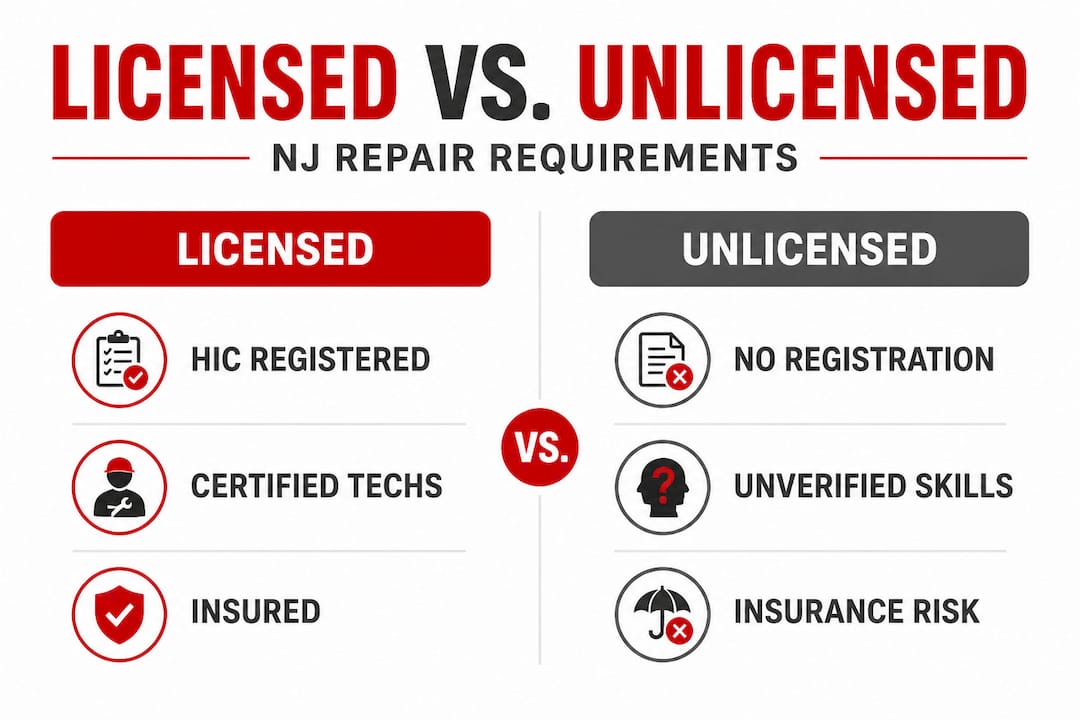
New Jersey does not issue a blanket “appliance repair license,” but it does have a well-defined framework that every legitimate repair professional must follow. The cornerstone of that framework is the Home Improvement Contractor (HIC) registration, which is managed by the NJ Division of Consumer Affairs. Any contractor performing home improvement work valued at $500 or more must hold this registration. Appliance repair that meets this threshold falls squarely within that definition.
HIC registration verifies that a contractor is a legitimate business entity, carries the appropriate insurance, and has agreed to follow New Jersey’s consumer protection laws. It also gives you a paper trail. If something goes wrong, you have a registered business name and license number to reference when filing a complaint.
Here’s a quick breakdown of what the HIC registration process involves for contractors:
| Requirement | Details |
|---|---|
| Business registration | Must be a registered NJ business entity |
| Insurance | General liability coverage required |
| Fee | Registration and renewal fees apply |
| Consumer protection | Must comply with NJ Consumer Fraud Act |
| Verification | Searchable through NJ Division of Consumer Affairs database |
Beyond HIC registration, different appliance types may require specialty certifications. A washer or dryer repair might only need the HIC registration plus hands-on experience, but appliances involving refrigerants, gas connections, or complex electronics often demand additional credentials. For those appliances, verifying appliance repair credentials in NJ is not optional. It’s the only way to know you’re protected.
Key things to check before hiring any repair service in New Jersey:
- Active HIC registration number (verify it online through the NJ Division of Consumer Affairs)
- General liability insurance with adequate coverage limits
- Specialty certifications relevant to the appliance type being repaired
- Written estimate or contract before any work begins
- Business address and verifiable references from local clients
Pro Tip: Never accept a verbal assurance of licensing. A legitimate technician will have their HIC registration number ready and welcome you to verify it. If someone hesitates when you ask, that’s a major red flag.
Understanding appliance repair certification in NJ is especially important for small business operators. Commercial kitchens, laundromats, and office spaces often have appliances running at higher capacity and frequency. Hiring an uncertified repair person in a commercial setting can affect your business’s own liability coverage and even your operating permits.
Risks of unlicensed repairs: What you need to know
Understanding the requirements is only half the battle. Here’s what happens when those requirements are ignored.
When a homeowner hires an unlicensed contractor, the consequences can snowball fast. It starts as a simple repair call and can end with a fire, a denied insurance claim, and a bill that dwarfs the original repair cost. This is not an exaggeration. Poor workmanship, fines up to $2,000, voided insurance claims, and electrical fire hazards are all documented outcomes for homeowners who unknowingly hired unlicensed contractors.
Let’s look at how licensed and unlicensed repair outcomes compare side by side:
| Factor | Licensed Repair | Unlicensed Repair |
|---|---|---|
| Accountability | Registered, traceable business | No formal recourse |
| Insurance protection | Claims remain valid | Insurance may deny claims |
| Workmanship quality | Trained, certified professionals | Inconsistent, often poor |
| Legal standing | Compliant with NJ law | Exposes both parties to penalties |
| Safety | Follows code and safety standards | Higher risk of hazards |
| Recourse if issues arise | Formal complaint process available | Little to no recourse |
Here are the most common risks homeowners face when choosing repair services without verifying credentials:
- Insurance denial: If an unlicensed contractor causes damage, your homeowner’s insurance may refuse to pay the claim because the work was done illegally.
- Electrical hazards: Appliances involve complex wiring. An unqualified repair can create shorts, sparks, or conditions that lead to a house fire.
- Repeat failures: Unlicensed technicians often apply quick fixes that mask deeper problems, causing the appliance to fail again within weeks.
- No warranty: Without proper credentials, any warranty on parts or labor is essentially meaningless.
- Financial penalties: New Jersey law can hold homeowners financially responsible for using unlicensed contractors, with fines reaching $2,000.
“Hiring unlicensed contractors puts homeowners at serious legal and financial risk, including liability for any injuries or property damage that occur during the job.” This principle applies directly to appliance repair in New Jersey, where consumer protection laws are strictly enforced.
For small business owners, the stakes are even higher. A failed appliance in a commercial setting can disrupt operations, create food safety violations, or damage inventory. Appliance service contracts in Monmouth County that include verified, licensed technicians offer ongoing protection so that a single bad repair call doesn’t derail your entire operation.

Special certifications: When standard licensing isn’t enough
Legal compliance matters, but some situations call for even deeper expertise and certifications.
If your refrigerator, commercial freezer, or wine cooler needs repair, you’re dealing with a refrigerant-based system. This is where the rules become even more specific and the consequences of cutting corners turn environmental. EPA 608 certification is legally required for any technician who handles refrigerants. Unlicensed handling is not just a fine-level offense. It carries serious environmental penalties because refrigerants are regulated substances under federal law.
This is a gap many repair guides fail to address clearly. Most people assume that any appliance tech can legally open a refrigerator’s sealed system and recharge it. That is simply not true. Without EPA 608 certification, a technician cannot legally purchase, recover, or handle refrigerants. Anyone doing so without the certification is breaking federal law.
Here’s a numbered breakdown of when you need more than just HIC registration:
- Refrigerant appliances (refrigerators, freezers, air conditioners): Require EPA 608 certification in addition to HIC registration.
- Gas-connected appliances (ranges, ovens, dryers): May require gas piping certification or licensed plumber involvement depending on the scope of work.
- High-voltage commercial appliances: May require additional electrical contractor licensing in New Jersey.
- Appliances under manufacturer warranty: Often require certified factory-trained technicians to maintain warranty validity.
- Commercial laundry equipment: May require NASTeC (National Appliance Service Technician Certification) for proper compliance.
As professional appliance technicians in NJ consistently demonstrate, the combination of HIC registration, EPA 608 certification, and NASTeC credentials provides the most complete professional standard for both residential and commercial repair work. While no single appliance repair license exists in NJ, this stack of credentials effectively creates that professional standard and ensures compliance for Monmouth County commercial spaces.
Statistic callout: Technicians who hold EPA 608 certification must pass a test covering refrigerant handling, safety, and environmental regulations. There are four certification types (Type I through Universal), and only Universal certification covers all equipment categories. Always confirm which type your technician holds for the specific appliance.
Pro Tip: Ask your technician directly which type of EPA 608 certification they hold before any refrigerant-related repair begins. A qualified tech will know exactly what type they have and what it covers. The value of experience in appliance repair shows up precisely in moments like this, where training and legal compliance intersect.
Small business owners managing Monmouth County commercial spaces should also confirm that their building’s insurance policy aligns with NJ requirements for contractor credentialing. Many commercial policies have language that denies claims if non-licensed contractors performed work that contributed to the loss.
How licensed repair improves outcomes and peace of mind
Once you know what credentials to look for, it’s time to focus on the tangible benefits you get by choosing licensed repair.
Beyond simply avoiding penalties, hiring a licensed and certified repair professional delivers measurable advantages in quality, reliability, and long-term appliance performance. These aren’t soft benefits. They translate directly into money saved, appliances that last longer, and a home or business that operates without unnecessary disruption.
Let’s break down the concrete advantages:
- Accountability you can act on: Because licensed contractors are registered through the NJ Division of Consumer Affairs, you have a formal complaint process if work is substandard. With an unlicensed tech, your only option is small claims court.
- Insurance stays intact: When a licensed contractor performs the repair, your homeowner’s or business insurance remains valid. This matters enormously if the appliance causes damage before or after the repair.
- Higher workmanship quality: HIC registration requirements include adherence to industry standards, which filters out underqualified repair persons before they ever reach your door.
- Transparency on pricing: Reputable, licensed contractors provide written estimates. You know exactly what you’re paying before work begins.
- Recourse and warranty: Licensed professionals typically offer warranties on parts and labor. That’s a guarantee that reflects confidence in their own work.
The benefits for NJ homeowners who consistently choose licensed repair extend beyond individual repairs. Appliances that are properly fixed the first time tend to last significantly longer. A refrigerator that’s patched up by someone who guessed at the problem will fail again. A refrigerator repaired by a certified technician who diagnosed the root cause will keep running smoothly.
Local expertise matters here too. A technician with deep Monmouth County appliance repair expertise knows the most common appliance brands in the area, the typical failure patterns for coastal and suburban home environments, and how to source the right parts quickly. That kind of local knowledge reduces repair time and improves the accuracy of first-visit diagnosis.
Pro Tip: Before scheduling any repair, ask the service provider for their HIC registration number and at least two local references. A company with nothing to hide will answer both requests immediately. If they stall, walk away.
What most guides miss about licensed repairs
Most online guides on this topic treat licensing as a checkbox. Verify the number, move on. But working with homeowners and small business operators in Monmouth County for decades has shown us something these guides consistently overlook: licensing is not just about legal compliance. It’s about the full relationship between you, your appliances, and the technician who services them.
New Jersey’s licensing framework creates a layer of accountability that goes beyond the individual job. When a contractor maintains active HIC registration, they are continuously monitored by the state. They can lose their registration for repeated consumer complaints or violations. That ongoing accountability changes how professionals behave. They’re not just fixing your washer today. They’re protecting their business tomorrow.
There’s also a deeper practical truth that rarely gets discussed: household and commercial appliance needs are genuinely different. Most guides assume you’re dealing with a residential refrigerator or washer. But many Monmouth County small business owners run equipment that handles commercial-grade loads daily. A repair tech who has only serviced residential units may not understand the stress points on commercial-grade equipment. This is exactly why certifications like NASTeC exist, and why hiring locally matters more than it might seem.
The best repair professionals we’ve seen in this area share three traits that go beyond credentials: they communicate clearly before, during, and after the repair; they explain what failed and why; and they give you realistic expectations about your appliance’s remaining useful life. True peace of mind doesn’t come from a license number on a document. It comes from working with someone who understands your specific situation and gives you honest information.
Boosting your home’s efficiency through properly maintained appliances is part of a larger picture. Licensed repair is the foundation. But ongoing communication, documented service history, and technicians who take pride in their work are what make the real difference over time.
Get reliable, certified appliance repair for your Monmouth County home or business
Ready to apply what you’ve learned? Here’s how to secure safe, professional help right in Monmouth County.
At Expert Appliance Repair, we’ve been serving Marlboro, NJ and surrounding Monmouth County communities since 1988. Every technician on our team carries the required HIC registration and relevant specialty certifications, so you never have to wonder whether your repair is legally compliant or safely performed.
Whether you need to know which appliance brands we repair, want to understand your options through our emergency appliance repair guide, or need to schedule same-day appliance service, we make it easy to get the right help fast. Our upfront pricing, 24/7 emergency availability, and documented credentials mean you get quality service without the guesswork. Reach out today and experience what licensed, experienced appliance repair actually feels like.
Frequently asked questions
Is an “appliance repair license” required in New Jersey?
No specific appliance repair license exists in NJ, but HIC registration plus certifications like EPA 608 and NASTeC create the required professional standard for both residential and commercial work.
What risks do homeowners face with unlicensed repair services?
Homeowners risk fines up to $2,000, unsafe workmanship, and denied insurance claims when using unlicensed repair services, in addition to potential electrical or fire hazards.
Do small businesses in Monmouth County have special requirements for appliance repair?
Yes, commercial spaces must ensure their contractors hold HIC registration and relevant certifications for legal and insurance compliance in New Jersey.
What certification is needed to repair appliances with refrigerant?
Repairing refrigerant-based appliances legally requires EPA 608 certification, and unlicensed handling carries federal environmental fines in addition to state penalties.
How can I verify a repair service is licensed in New Jersey?
Search the contractor’s name or registration number through the NJ Division of Consumer Affairs database, and always request documentation and proof of specialty certifications before work begins.
Recommended
- The Importance of Commercial Appliance Repair for Businesses – Expert Appliance
- Why a Family-Owned Appliance Repair Company is Your Best Choice – Expert Appliance
- Understanding Emergency Appliance Repair – Expert Appliance
- Role of Appliance Repair for Businesses: Protecting Productivity – Expert Appliance